

Mimikatz-style credential dumping depends on a handful of registry values. Check them across your Windows fleet with Ruby’s bundled win32/registry.
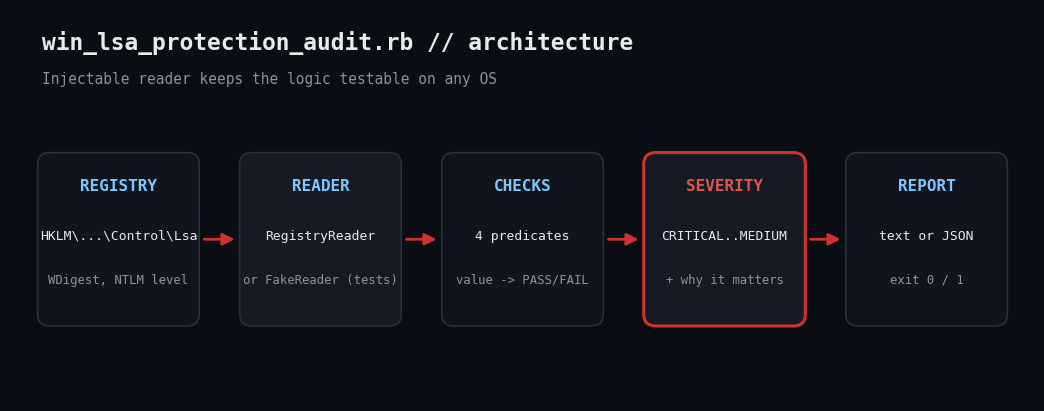
Step through the build below:
Attackers who land on a Windows host go after LSASS memory for cached credentials. Four registry settings decide how bad that is: RunAsPPL makes LSASS a protected process, UseLogonCredential controls cleartext WDigest caching, LmCompatibilityLevel governs NTLM strength, and everyoneincludesanonymous widens anonymous access. Checking them by hand across servers does not scale.
#!/usr/bin/env ruby
# frozen_string_literal: true
#
# win_lsa_protection_audit.rb - Audit Windows credential-protection registry settings.
#
# Checks: LSA protected process (RunAsPPL), WDigest cleartext caching
# (UseLogonCredential), NTLM compatibility level (LmCompatibilityLevel) and
# "Everyone includes Anonymous" (everyoneincludesanonymous).
#
# Windows only for real use (needs the win32/registry stdlib). The checking logic
# takes any object responding to #read(key, name), so it is unit-testable on Linux.
#
# Usage:  ruby win_lsa_protection_audit.rb [--json] [--self-test]
# Exit:   0 = compliant, 1 = findings
require 'json'
require 'optparse'
# key path (under HKLM), value name, predicate, severity, why, remediation
CHECKS = [
  { key: 'SYSTEM\CurrentControlSet\Control\Lsa', name: 'RunAsPPL', sev: 'HIGH',
    ok: ->(v) { [1, 2].include?(v) }, want: '1 or 2',
    why: 'LSASS is not a protected process; credential dumpers can read its memory.' },
  { key: 'SYSTEM\CurrentControlSet\Control\SecurityProviders\WDigest', name: 'UseLogonCredential', sev: 'CRITICAL',
    ok: ->(v) { v.nil? || v.zero? }, want: '0 or absent',
    why: 'WDigest keeps cleartext passwords in LSASS memory.' },
  { key: 'SYSTEM\CurrentControlSet\Control\Lsa', name: 'LmCompatibilityLevel', sev: 'MEDIUM',
    ok: ->(v) { !v.nil? && v >= 5 }, want: '5',
    why: 'Allows LM/NTLMv1 authentication, which is trivially crackable.' },
  { key: 'SYSTEM\CurrentControlSet\Control\Lsa', name: 'everyoneincludesanonymous', sev: 'MEDIUM',
    ok: ->(v) { v.nil? || v.zero? }, want: '0',
    why: 'Anonymous users receive the permissions granted to Everyone.' }
].freeze
# Real reader: uses Ruby's bundled win32/registry (Windows only).
class RegistryReader
  def initialize
    require 'win32/registry'
  end
  def read(key, name)
    Win32::Registry::HKEY_LOCAL_MACHINE.open(key, Win32::Registry::KEY_READ) { |r| r[name] }
  rescue Win32::Registry::Error
    nil # key or value absent
  end
end
# Test double: hash of "KEY\\NAME" => value
class FakeReader
  def initialize(data) = @data = data
  def read(key, name) = @data["#{key}\\#{name}"]
end
def run_checks(reader)
  CHECKS.map do |c|
    val = reader.read(c[:key], c[:name])
    pass = c[:ok].call(val)
    { setting: c[:name], value: val.nil? ? 'absent' : val, expected: c[:want],
      status: pass ? 'PASS' : 'FAIL', severity: pass ? '-' : c[:sev], why: pass ? '' : c[:why] }
  end
end
def self_test
  lsa = 'SYSTEM\CurrentControlSet\Control\Lsa'
  wd  = 'SYSTEM\CurrentControlSet\Control\SecurityProviders\WDigest'
  good = FakeReader.new("#{lsa}\\RunAsPPL" => 1, "#{lsa}\\LmCompatibilityLevel" => 5)
  bad  = FakeReader.new("#{wd}\\UseLogonCredential" => 1, "#{lsa}\\LmCompatibilityLevel" => 3)
  g = run_checks(good); b = run_checks(bad)
  raise 'good config should pass' unless g.all? { |r| r[:status] == 'PASS' }
  raise 'bad config should fail 3 checks' unless b.count { |r| r[:status] == 'FAIL' } == 3
  puts 'self-test OK (good: 4/4 PASS, bad: 3 FAIL)'
  puts 'sample findings for a weak host:'
  b
end
opts = { json: false, self_test: false }
OptionParser.new do |o|
  o.on('--json') { opts[:json] = true }
  o.on('--self-test', 'run against fake registry data (any OS)') { opts[:self_test] = true }
end.parse!
results = opts[:self_test] ? self_test : run_checks(RegistryReader.new)
if opts[:json]
  puts JSON.pretty_generate(results)
else
  results.each do |r|
    puts format('%-28s %-7s value=%-7s want=%-11s %s', r[:setting], r[:status], r[:value], r[:expected], r[:severity])
    puts "    -> #{r[:why]}" unless r[:why].empty?
  end
end
exit(results.any? { |r| r[:status] == 'FAIL' } ? 1 : 0)
1. Declarative checks. Each entry in CHECKS holds the key, value name, a lambda that decides pass/fail, severity, and a plain-English reason. WDigest passes when absent because modern Windows defaults it off.
2. Injectable reader. RegistryReader wraps Win32::Registry::HKEY_LOCAL_MACHINE and returns nil for absent values. FakeReader serves a Hash. Both expose #read(key, name), so run_checks does not care which it gets.
3. Self-test. --self-test feeds a good and a weak configuration through the real logic and raises if the expected results differ.
4. Report. Each setting prints PASS/FAIL, observed value, expected value and severity, with the reason on failures. Exit 1 on any failure.
self-test OK (good: 4/4 PASS, bad: 3 FAIL)
sample findings for a weak host:
RunAsPPL                     FAIL    value=absent  want=1 or 2      HIGH
    -> LSASS is not a protected process; credential dumpers can read its memory.
UseLogonCredential           FAIL    value=1       want=0 or absent CRITICAL
    -> WDigest keeps cleartext passwords in LSASS memory.
LmCompatibilityLevel         FAIL    value=3       want=5           MEDIUM
    -> Allows LM/NTLMv1 authentication, which is trivially crackable.
everyoneincludesanonymous    PASS    value=absent  want=0           -
Full script + README on GitHub: ruby-devops-toolkit/win-lsa-protection-audit
What you need
- Ruby 3.x for Windows (RubyInstaller);
win32/registryships with Ruby - Run in an elevated prompt for consistent registry access (read-only, changes nothing)
- Linux/macOS can run
--self-testonly
Complete code
#!/usr/bin/env ruby
# frozen_string_literal: true
#
# win_lsa_protection_audit.rb - Audit Windows credential-protection registry settings.
#
# Checks: LSA protected process (RunAsPPL), WDigest cleartext caching
# (UseLogonCredential), NTLM compatibility level (LmCompatibilityLevel) and
# "Everyone includes Anonymous" (everyoneincludesanonymous).
#
# Windows only for real use (needs the win32/registry stdlib). The checking logic
# takes any object responding to #read(key, name), so it is unit-testable on Linux.
#
# Usage:  ruby win_lsa_protection_audit.rb [--json] [--self-test]
# Exit:   0 = compliant, 1 = findings
require 'json'
require 'optparse'
# key path (under HKLM), value name, predicate, severity, why, remediation
CHECKS = [
  { key: 'SYSTEM\CurrentControlSet\Control\Lsa', name: 'RunAsPPL', sev: 'HIGH',
    ok: ->(v) { [1, 2].include?(v) }, want: '1 or 2',
    why: 'LSASS is not a protected process; credential dumpers can read its memory.' },
  { key: 'SYSTEM\CurrentControlSet\Control\SecurityProviders\WDigest', name: 'UseLogonCredential', sev: 'CRITICAL',
    ok: ->(v) { v.nil? || v.zero? }, want: '0 or absent',
    why: 'WDigest keeps cleartext passwords in LSASS memory.' },
  { key: 'SYSTEM\CurrentControlSet\Control\Lsa', name: 'LmCompatibilityLevel', sev: 'MEDIUM',
    ok: ->(v) { !v.nil? && v >= 5 }, want: '5',
    why: 'Allows LM/NTLMv1 authentication, which is trivially crackable.' },
  { key: 'SYSTEM\CurrentControlSet\Control\Lsa', name: 'everyoneincludesanonymous', sev: 'MEDIUM',
    ok: ->(v) { v.nil? || v.zero? }, want: '0',
    why: 'Anonymous users receive the permissions granted to Everyone.' }
].freeze
# Real reader: uses Ruby's bundled win32/registry (Windows only).
class RegistryReader
  def initialize
    require 'win32/registry'
  end
  def read(key, name)
    Win32::Registry::HKEY_LOCAL_MACHINE.open(key, Win32::Registry::KEY_READ) { |r| r[name] }
  rescue Win32::Registry::Error
    nil # key or value absent
  end
end
# Test double: hash of "KEY\\NAME" => value
class FakeReader
  def initialize(data) = @data = data
  def read(key, name) = @data["#{key}\\#{name}"]
end
def run_checks(reader)
  CHECKS.map do |c|
    val = reader.read(c[:key], c[:name])
    pass = c[:ok].call(val)
    { setting: c[:name], value: val.nil? ? 'absent' : val, expected: c[:want],
      status: pass ? 'PASS' : 'FAIL', severity: pass ? '-' : c[:sev], why: pass ? '' : c[:why] }
  end
end
def self_test
  lsa = 'SYSTEM\CurrentControlSet\Control\Lsa'
  wd  = 'SYSTEM\CurrentControlSet\Control\SecurityProviders\WDigest'
  good = FakeReader.new("#{lsa}\\RunAsPPL" => 1, "#{lsa}\\LmCompatibilityLevel" => 5)
  bad  = FakeReader.new("#{wd}\\UseLogonCredential" => 1, "#{lsa}\\LmCompatibilityLevel" => 3)
  g = run_checks(good); b = run_checks(bad)
  raise 'good config should pass' unless g.all? { |r| r[:status] == 'PASS' }
  raise 'bad config should fail 3 checks' unless b.count { |r| r[:status] == 'FAIL' } == 3
  puts 'self-test OK (good: 4/4 PASS, bad: 3 FAIL)'
  puts 'sample findings for a weak host:'
  b
end
opts = { json: false, self_test: false }
OptionParser.new do |o|
  o.on('--json') { opts[:json] = true }
  o.on('--self-test', 'run against fake registry data (any OS)') { opts[:self_test] = true }
end.parse!
results = opts[:self_test] ? self_test : run_checks(RegistryReader.new)
if opts[:json]
  puts JSON.pretty_generate(results)
else
  results.each do |r|
    puts format('%-28s %-7s value=%-7s want=%-11s %s', r[:setting], r[:status], r[:value], r[:expected], r[:severity])
    puts "    -> #{r[:why]}" unless r[:why].empty?
  end
end
exit(results.any? { |r| r[:status] == 'FAIL' } ? 1 : 0)
How it works
1. Declarative checks
Each entry in CHECKS holds the key, value name, a lambda that decides pass/fail, severity, and a plain-English reason. WDigest passes when absent because modern Windows defaults it off.
2. Injectable reader
RegistryReader wraps Win32::Registry::HKEY_LOCAL_MACHINE and returns nil for absent values. FakeReader serves a Hash. Both expose #read(key, name), so run_checks does not care which it gets.
3. Self-test
--self-test feeds a good and a weak configuration through the real logic and raises if the expected results differ.
4. Report
Each setting prints PASS/FAIL, observed value, expected value and severity, with the reason on failures. Exit 1 on any failure.
What you will see
self-test OK (good: 4/4 PASS, bad: 3 FAIL)
sample findings for a weak host:
RunAsPPL                     FAIL    value=absent  want=1 or 2      HIGH
    -> LSASS is not a protected process; credential dumpers can read its memory.
UseLogonCredential           FAIL    value=1       want=0 or absent CRITICAL
    -> WDigest keeps cleartext passwords in LSASS memory.
LmCompatibilityLevel         FAIL    value=3       want=5           MEDIUM
    -> Allows LM/NTLMv1 authentication, which is trivially crackable.
everyoneincludesanonymous    PASS    value=absent  want=0           -
When it misbehaves
- Honest caveat: the real
win32/registrypath cannot execute on Linux. I verified the check logic with theFakeReaderharness (the output tab), and the registry wrapper is a few lines you should smoke-test on one Windows host first. RunAsPPLonly takes effect after reboot; a FAIL right after enabling may be pending a restart.- Group Policy may overwrite values; audit the effective (live) registry, as this does.
Extending it
- Add
HKLM\SYSTEM\CurrentControlSet\Control\DeviceGuard(Credential Guard) checks. - Run via WinRM across a fleet and aggregate the JSON.
- Add a
--fixmode gated behind confirmation.