

Re-scanning the whole Windows Event Log every cron run either misses nothing-changed windows or repeats itself. A small WMI query with a persisted watermark fixes that in stock Ruby, no PowerShell required.
Step through the build below:
Get-WinEvent is the modern interactive way to read the event log, but a lot of shops run scheduled Ruby tooling alongside PowerShell, and re-scanning the whole log every cron run either misses nothing-changed windows or floods you with the same events repeatedly.
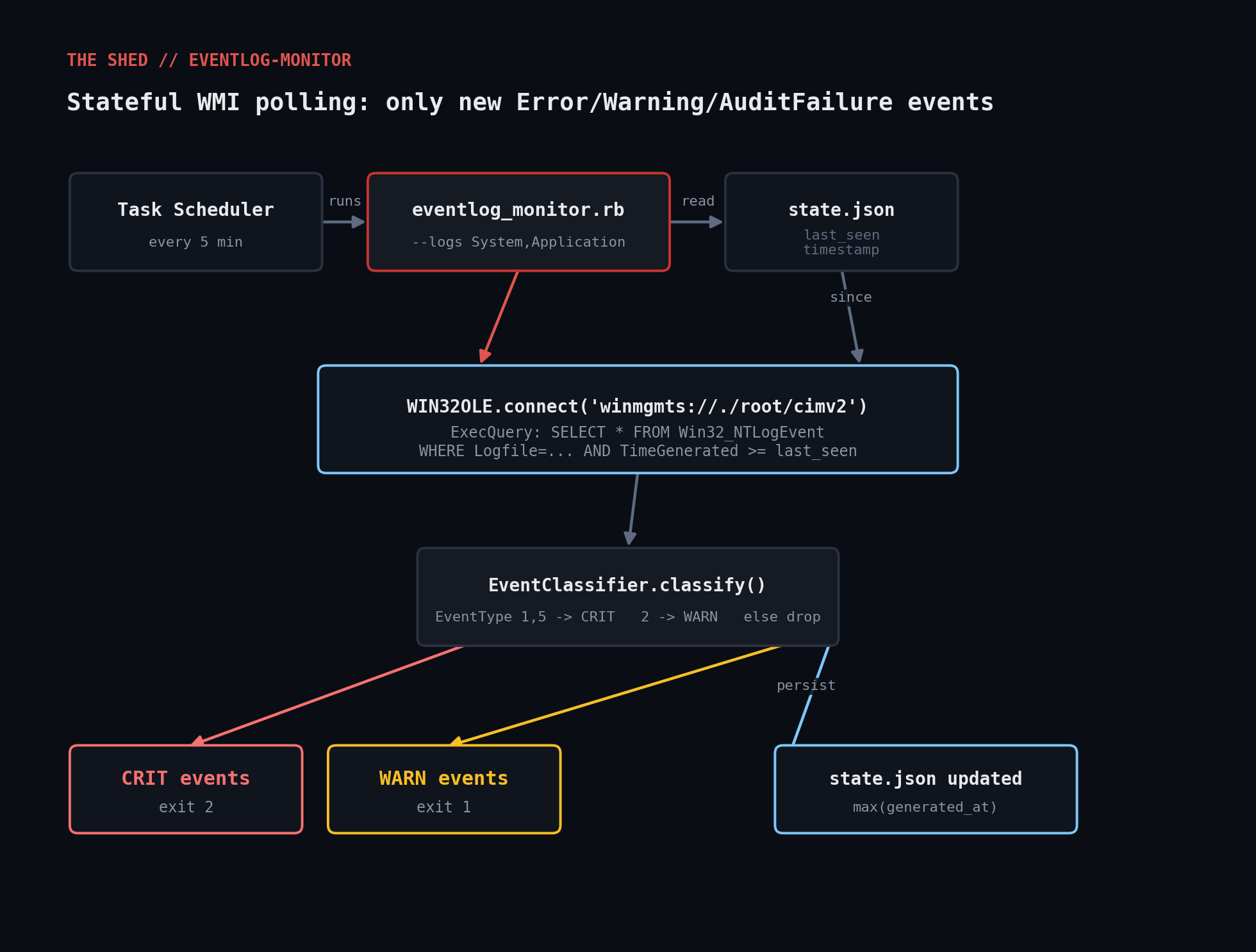
eventlog_monitor.rb polls Win32_NTLogEvent via WMI, classifies Error/Warning/Audit-Failure events, and persists the last-seen timestamp between runs so a 5-minute Task Scheduler job only ever reports genuinely new events.
#!/usr/bin/env ruby
# frozen_string_literal: true
#
# eventlog_monitor.rb — poll the Windows Event Log (System/Application, or
# any log you name) via WMI for new Error/Warning/Audit-Failure events since
# the last run, classify them, and report — cron/Task-Scheduler friendly.
#
# Why this exists: `Get-WinEvent` in PowerShell is the modern way to read
# the event log interactively, but a lot of shops still run scheduled Ruby
# tooling alongside PowerShell, and WMI's Win32_NTLogEvent class is exactly
# as readable from Ruby (via WIN32OLE) as it is from PowerShell or VBScript
# — no gems required, just the win32ole standard library that ships with
# Ruby on Windows. This script tracks "last seen" state between runs so a
# 5-minute cron job only ever reports genuinely new events, not the same
# noisy log spam every single run.
#
# Usage (run ON a Windows host, from an elevated prompt is not required to
# *read* the event log, only to clear it):
#   ruby eventlog_monitor.rb --logs System,Application
#   ruby eventlog_monitor.rb --logs System --since-minutes 120 --json
#   ruby eventlog_monitor.rb --logs System,Application --exclude-source "Print Spooler"
#
# Exit codes (cron/Task Scheduler-friendly):
#   0 = no new Error/Warning/Audit-Failure events
#   1 = new Warning events only
#   2 = new Error or Audit-Failure events
require 'optparse'
require 'json'
require 'time'
require 'fileutils'
# ---------------------------------------------------------------------------
# EventRecord: one normalized row out of Win32_NTLogEvent.
# ---------------------------------------------------------------------------
EventRecord = Struct.new(:log, :record_number, :event_code, :event_type, :source,
                          :computer, :generated_at, :message, :level, keyword_init: true) do
  def to_h
    h = super
    h[:generated_at] = generated_at.is_a?(Time) ? generated_at.iso8601 : generated_at
    h
  end
end
# EventType, per the Win32_NTLogEvent WMI class:
#   1 = Error, 2 = Warning, 3 = Information, 4 = Security Audit Success,
#   5 = Security Audit Failure
EVENT_TYPE_NAMES = {
  1 => 'Error', 2 => 'Warning', 3 => 'Information',
  4 => 'AuditSuccess', 5 => 'AuditFailure'
}.freeze
# ---------------------------------------------------------------------------
# WmiDateTime: converts between Ruby Time and the WMI CIM_DATETIME string
# format (yyyymmddHHMMSS.mmmmmm+UUU, where UUU is the UTC offset in minutes).
# Pulled out as its own module because it's pure string logic that both the
# real WMI query and the test suite need, with no WIN32OLE dependency.
# ---------------------------------------------------------------------------
module WmiDateTime
  # NOTE: deliberately named `to_wmi`, not `format` — a module method named
  # `format` shadows Kernel#format for every other `self.`-method in this
  # same module (self inside a module method IS the module, so a bare
  # `format(...)` call resolves to the module's own singleton method
  # first). Learned that the hard way while writing this script: `parse`
  # below silently returned nil because its `format(...)` call was being
  # routed into this method instead of Kernel#format. Use `sprintf` for
  # string interpolation instead of `format`/`Kernel#format` inside this
  # module to keep that footgun from coming back.
  def self.to_wmi(time)
    utc = time.getutc
    "#{utc.strftime('%Y%m%d%H%M%S')}.000000+000"
  end
  def self.parse(wmi_str)
    # e.g. "20260801143022.500000-300" -> 2026-08-01 14:30:22 local, UTC-300min
    m = wmi_str.to_s.match(/^(\d{4})(\d{2})(\d{2})(\d{2})(\d{2})(\d{2})\.\d+([+-]\d{3})$/)
    return nil unless m
    year, mon, day, hour, min, sec, offset_min = m.captures
    offset_min = offset_min.to_i
    sign = offset_min.negative? ? '-' : '+'
    offset_min = offset_min.abs
    offset_str = sprintf('%s%02d:%02d', sign, offset_min / 60, offset_min % 60)
    Time.new(year.to_i, mon.to_i, day.to_i, hour.to_i, min.to_i, sec.to_i, offset_str)
  rescue ArgumentError
    nil
  end
end
# ---------------------------------------------------------------------------
# EventClassifier: pure logic — turns a raw WMI-shaped record into an
# EventRecord with a severity level. No WIN32OLE dependency, fully unit
# testable on any platform.
# ---------------------------------------------------------------------------
class EventClassifier
  def initialize(exclude_sources: [], include_types: [1, 2, 5])
    @exclude_sources = exclude_sources.map(&:downcase)
    @include_types = include_types
  end
  # `raw` only needs to respond to the Win32_NTLogEvent property names we
  # use: LogFile, RecordNumber, EventCode, EventType, SourceName,
  # ComputerName, TimeGenerated, Message.
  def classify(raw)
    return nil unless @include_types.include?(raw.EventType.to_i)
    return nil if @exclude_sources.include?(raw.SourceName.to_s.downcase)
    level = case raw.EventType.to_i
            when 1, 5 then :crit
            when 2 then :warn
            else :info
            end
    EventRecord.new(
      log: raw.LogFile,
      record_number: raw.RecordNumber.to_i,
      event_code: raw.EventCode.to_i,
      event_type: EVENT_TYPE_NAMES[raw.EventType.to_i] || raw.EventType.to_s,
      source: raw.SourceName,
      computer: raw.ComputerName,
      generated_at: WmiDateTime.parse(raw.TimeGenerated) || raw.TimeGenerated,
      message: raw.Message.to_s.split("\n").first.to_s.strip,
      level: level
    )
  end
end
# ---------------------------------------------------------------------------
# EventLogMonitor: connects to WMI (root/cimv2), runs the WQL query, tracks
# "since" state between runs, and returns classified EventRecords.
# ---------------------------------------------------------------------------
class EventLogMonitor
  def initialize(logs:, since_minutes: 60, exclude_sources: [], state_file: nil,
                 wmi_connector: nil, logger: $stderr)
    @logs = logs
    @since_minutes = since_minutes
    @classifier = EventClassifier.new(exclude_sources: exclude_sources)
    @state_file = state_file || default_state_file
    # `wmi_connector` is injected in tests; in production it's built lazily
    # so requiring this file on a non-Windows host (e.g. to run rubocop or
    # the unit tests in CI) doesn't blow up on a missing win32ole.
    @wmi_connector = wmi_connector
    @logger = logger
  end
  def run
    since = load_since_time
    raw_events = query_events(since)
    events = raw_events.map { |r| @classifier.classify(r) }.compact
                        .sort_by(&:record_number)
    save_since_time(events)
    events
  end
  private
  def connector
    @wmi_connector ||= build_real_wmi_connector
  end
  def build_real_wmi_connector
    begin
      require 'win32ole'
    rescue LoadError
      raise "win32ole is not available (this script must run on Windows with a stock " \
            "Ruby install — see the tutorial's Troubleshooting section)"
    end
    WIN32OLE.connect('winmgmts://./root/cimv2')
  end
  def query_events(since)
    log_clause = @logs.map { |l| "Logfile='#{l}'" }.join(' OR ')
    wql = "SELECT * FROM Win32_NTLogEvent WHERE (#{log_clause}) " \
          "AND TimeGenerated >= '#{WmiDateTime.to_wmi(since)}'"
    log("query: #{wql}")
    connector.ExecQuery(wql).to_a
  end
  def load_since_time
    return Time.now - (@since_minutes * 60) unless File.exist?(@state_file)
    data = JSON.parse(File.read(@state_file))
    Time.parse(data['last_seen'])
  rescue JSON::ParserError, TypeError, ArgumentError
    Time.now - (@since_minutes * 60)
  end
  def save_since_time(events)
    latest = events.map(&:generated_at).select { |t| t.is_a?(Time) }.max || Time.now
    FileUtils.mkdir_p(File.dirname(@state_file))
    File.write(@state_file, JSON.pretty_generate(last_seen: latest.iso8601))
  rescue StandardError => e
    log("could not persist state file #{@state_file}: #{e.message}")
  end
  def default_state_file
    base = ENV['ProgramData'] || ENV['TEMP'] || '.'
    File.join(base, 'eventlog_monitor', 'state.json')
  end
  def log(msg)
    @logger.puts("[eventlog_monitor] #{msg}")
  end
end
# ---------------------------------------------------------------------------
# CLI
# ---------------------------------------------------------------------------
if $PROGRAM_NAME == __FILE__
  options = {
    logs: %w[System Application],
    since_minutes: 60,
    exclude_sources: [],
    json: false,
    state_file: nil
  }
  OptionParser.new do |opts|
    opts.banner = 'Usage: eventlog_monitor.rb [options]'
    opts.on('--logs LIST', 'Comma-separated log names (default: System,Application)') do |v|
      options[:logs] = v.split(',').map(&:strip)
    end
    opts.on('--since-minutes N', Integer, 'Lookback window on first run (default 60)') do |v|
      options[:since_minutes] = v
    end
    opts.on('--exclude-source NAME', 'Ignore events from this SourceName (repeatable)') do |v|
      options[:exclude_sources] << v
    end
    opts.on('--state-file PATH', 'Where to persist the last-seen timestamp') { |v| options[:state_file] = v }
    opts.on('--json', 'Emit machine-readable JSON instead of text') { options[:json] = true }
    opts.on('-h', '--help') { puts opts; exit 0 }
  end.parse!
  monitor = EventLogMonitor.new(
    logs: options[:logs],
    since_minutes: options[:since_minutes],
    exclude_sources: options[:exclude_sources],
    state_file: options[:state_file]
  )
  begin
    events = monitor.run
  rescue StandardError => e
    warn "eventlog_monitor: #{e.message}"
    exit 3
  end
  crit = events.count { |e| e.level == :crit }
  warn_count = events.count { |e| e.level == :warn }
  if options[:json]
    puts JSON.pretty_generate(
      generated_at: Time.now.iso8601,
      crit: crit,
      warn: warn_count,
      events: events.map(&:to_h)
    )
  else
    events.each do |e|
      tag = { crit: 'CRIT', warn: 'WARN' }[e.level]
      ts = e.generated_at.is_a?(Time) ? e.generated_at.strftime('%Y-%m-%d %H:%M:%S') : e.generated_at
      puts "#{tag} [#{e.log}] #{ts} #{e.source} (##{e.event_code}): #{e.message}"
    end
    puts "\n#{events.size} new event(s): #{crit} crit, #{warn_count} warn"
  end
  exit(crit.positive? ? 2 : (warn_count.positive? ? 1 : 0))
end
WmiDateTime converts between Ruby Time and WMI’s CIM_DATETIME string format (UTC offset in minutes, not hours).
EventClassifier is pure logic with zero WIN32OLE dependency — any object that duck-types the Win32_NTLogEvent properties works, which is exactly what makes it unit-testable off Windows.
The WIN32OLE connection is built lazily so the file loads fine on any platform and fails with one clear message, not a stack trace, when WMI genuinely isn’t available.
$ ruby eventlog_monitor_test.rb
PASS  WmiDateTime.to_wmi produces a valid CIM_DATETIME string
PASS  WmiDateTime.parse round-trips a real Win32_NTLogEvent TimeGenerated value
PASS  WmiDateTime.parse returns nil for garbage input
PASS  EventType 1 (Error) classifies as :crit
PASS  EventType 2 (Warning) classifies as :warn
PASS  EventType 5 (Audit Failure) classifies as :crit
PASS  EventType 3 (Information) is filtered out entirely (nil)
PASS  excluded source names are filtered out
PASS  classify() only keeps the first line of a multi-line Message
PASS  run() returns events sorted by record number with correct levels
PASS  state file is written with the latest generated_at after a run
PASS  a second run queries TimeGenerated using the persisted state, not the default lookback
ALL TESTS PASSED
$ ruby eventlog_monitor.rb --logs System
[eventlog_monitor] query: SELECT * FROM Win32_NTLogEvent WHERE (Logfile='System') AND TimeGenerated >= '20260801164554.000000+000'
eventlog_monitor: win32ole is not available (this script must run on Windows with a stock Ruby install -- see the tutorial's Troubleshooting section)
$ echo $?
3
Full script + README on GitHub: ruby-devops-toolkit/eventlog-monitor
Prerequisites
- Windows with a stock Ruby install (RubyInstaller) —
win32oleships in the standard library, no gem install needed. - Permission to read the event logs you name (reading System/Application doesn’t require elevation for a standard user in most default configurations; some hardened environments restrict it further).
- Ruby 2.7+ — the rest is stdlib:
optparse,json,time,fileutils.
The Complete Script
#!/usr/bin/env ruby
# frozen_string_literal: true
#
# eventlog_monitor.rb — poll the Windows Event Log (System/Application, or
# any log you name) via WMI for new Error/Warning/Audit-Failure events since
# the last run, classify them, and report — cron/Task-Scheduler friendly.
#
# Why this exists: `Get-WinEvent` in PowerShell is the modern way to read
# the event log interactively, but a lot of shops still run scheduled Ruby
# tooling alongside PowerShell, and WMI's Win32_NTLogEvent class is exactly
# as readable from Ruby (via WIN32OLE) as it is from PowerShell or VBScript
# — no gems required, just the win32ole standard library that ships with
# Ruby on Windows. This script tracks "last seen" state between runs so a
# 5-minute cron job only ever reports genuinely new events, not the same
# noisy log spam every single run.
#
# Usage (run ON a Windows host, from an elevated prompt is not required to
# *read* the event log, only to clear it):
#   ruby eventlog_monitor.rb --logs System,Application
#   ruby eventlog_monitor.rb --logs System --since-minutes 120 --json
#   ruby eventlog_monitor.rb --logs System,Application --exclude-source "Print Spooler"
#
# Exit codes (cron/Task Scheduler-friendly):
#   0 = no new Error/Warning/Audit-Failure events
#   1 = new Warning events only
#   2 = new Error or Audit-Failure events
require 'optparse'
require 'json'
require 'time'
require 'fileutils'
# ---------------------------------------------------------------------------
# EventRecord: one normalized row out of Win32_NTLogEvent.
# ---------------------------------------------------------------------------
EventRecord = Struct.new(:log, :record_number, :event_code, :event_type, :source,
                          :computer, :generated_at, :message, :level, keyword_init: true) do
  def to_h
    h = super
    h[:generated_at] = generated_at.is_a?(Time) ? generated_at.iso8601 : generated_at
    h
  end
end
# EventType, per the Win32_NTLogEvent WMI class:
#   1 = Error, 2 = Warning, 3 = Information, 4 = Security Audit Success,
#   5 = Security Audit Failure
EVENT_TYPE_NAMES = {
  1 => 'Error', 2 => 'Warning', 3 => 'Information',
  4 => 'AuditSuccess', 5 => 'AuditFailure'
}.freeze
# ---------------------------------------------------------------------------
# WmiDateTime: converts between Ruby Time and the WMI CIM_DATETIME string
# format (yyyymmddHHMMSS.mmmmmm+UUU, where UUU is the UTC offset in minutes).
# Pulled out as its own module because it's pure string logic that both the
# real WMI query and the test suite need, with no WIN32OLE dependency.
# ---------------------------------------------------------------------------
module WmiDateTime
  # NOTE: deliberately named `to_wmi`, not `format` — a module method named
  # `format` shadows Kernel#format for every other `self.`-method in this
  # same module (self inside a module method IS the module, so a bare
  # `format(...)` call resolves to the module's own singleton method
  # first). Learned that the hard way while writing this script: `parse`
  # below silently returned nil because its `format(...)` call was being
  # routed into this method instead of Kernel#format. Use `sprintf` for
  # string interpolation instead of `format`/`Kernel#format` inside this
  # module to keep that footgun from coming back.
  def self.to_wmi(time)
    utc = time.getutc
    "#{utc.strftime('%Y%m%d%H%M%S')}.000000+000"
  end
  def self.parse(wmi_str)
    # e.g. "20260801143022.500000-300" -> 2026-08-01 14:30:22 local, UTC-300min
    m = wmi_str.to_s.match(/^(\d{4})(\d{2})(\d{2})(\d{2})(\d{2})(\d{2})\.\d+([+-]\d{3})$/)
    return nil unless m
    year, mon, day, hour, min, sec, offset_min = m.captures
    offset_min = offset_min.to_i
    sign = offset_min.negative? ? '-' : '+'
    offset_min = offset_min.abs
    offset_str = sprintf('%s%02d:%02d', sign, offset_min / 60, offset_min % 60)
    Time.new(year.to_i, mon.to_i, day.to_i, hour.to_i, min.to_i, sec.to_i, offset_str)
  rescue ArgumentError
    nil
  end
end
# ---------------------------------------------------------------------------
# EventClassifier: pure logic — turns a raw WMI-shaped record into an
# EventRecord with a severity level. No WIN32OLE dependency, fully unit
# testable on any platform.
# ---------------------------------------------------------------------------
class EventClassifier
  def initialize(exclude_sources: [], include_types: [1, 2, 5])
    @exclude_sources = exclude_sources.map(&:downcase)
    @include_types = include_types
  end
  # `raw` only needs to respond to the Win32_NTLogEvent property names we
  # use: LogFile, RecordNumber, EventCode, EventType, SourceName,
  # ComputerName, TimeGenerated, Message.
  def classify(raw)
    return nil unless @include_types.include?(raw.EventType.to_i)
    return nil if @exclude_sources.include?(raw.SourceName.to_s.downcase)
    level = case raw.EventType.to_i
            when 1, 5 then :crit
            when 2 then :warn
            else :info
            end
    EventRecord.new(
      log: raw.LogFile,
      record_number: raw.RecordNumber.to_i,
      event_code: raw.EventCode.to_i,
      event_type: EVENT_TYPE_NAMES[raw.EventType.to_i] || raw.EventType.to_s,
      source: raw.SourceName,
      computer: raw.ComputerName,
      generated_at: WmiDateTime.parse(raw.TimeGenerated) || raw.TimeGenerated,
      message: raw.Message.to_s.split("\n").first.to_s.strip,
      level: level
    )
  end
end
# ---------------------------------------------------------------------------
# EventLogMonitor: connects to WMI (root/cimv2), runs the WQL query, tracks
# "since" state between runs, and returns classified EventRecords.
# ---------------------------------------------------------------------------
class EventLogMonitor
  def initialize(logs:, since_minutes: 60, exclude_sources: [], state_file: nil,
                 wmi_connector: nil, logger: $stderr)
    @logs = logs
    @since_minutes = since_minutes
    @classifier = EventClassifier.new(exclude_sources: exclude_sources)
    @state_file = state_file || default_state_file
    # `wmi_connector` is injected in tests; in production it's built lazily
    # so requiring this file on a non-Windows host (e.g. to run rubocop or
    # the unit tests in CI) doesn't blow up on a missing win32ole.
    @wmi_connector = wmi_connector
    @logger = logger
  end
  def run
    since = load_since_time
    raw_events = query_events(since)
    events = raw_events.map { |r| @classifier.classify(r) }.compact
                        .sort_by(&:record_number)
    save_since_time(events)
    events
  end
  private
  def connector
    @wmi_connector ||= build_real_wmi_connector
  end
  def build_real_wmi_connector
    begin
      require 'win32ole'
    rescue LoadError
      raise "win32ole is not available (this script must run on Windows with a stock " \
            "Ruby install — see the tutorial's Troubleshooting section)"
    end
    WIN32OLE.connect('winmgmts://./root/cimv2')
  end
  def query_events(since)
    log_clause = @logs.map { |l| "Logfile='#{l}'" }.join(' OR ')
    wql = "SELECT * FROM Win32_NTLogEvent WHERE (#{log_clause}) " \
          "AND TimeGenerated >= '#{WmiDateTime.to_wmi(since)}'"
    log("query: #{wql}")
    connector.ExecQuery(wql).to_a
  end
  def load_since_time
    return Time.now - (@since_minutes * 60) unless File.exist?(@state_file)
    data = JSON.parse(File.read(@state_file))
    Time.parse(data['last_seen'])
  rescue JSON::ParserError, TypeError, ArgumentError
    Time.now - (@since_minutes * 60)
  end
  def save_since_time(events)
    latest = events.map(&:generated_at).select { |t| t.is_a?(Time) }.max || Time.now
    FileUtils.mkdir_p(File.dirname(@state_file))
    File.write(@state_file, JSON.pretty_generate(last_seen: latest.iso8601))
  rescue StandardError => e
    log("could not persist state file #{@state_file}: #{e.message}")
  end
  def default_state_file
    base = ENV['ProgramData'] || ENV['TEMP'] || '.'
    File.join(base, 'eventlog_monitor', 'state.json')
  end
  def log(msg)
    @logger.puts("[eventlog_monitor] #{msg}")
  end
end
# ---------------------------------------------------------------------------
# CLI
# ---------------------------------------------------------------------------
if $PROGRAM_NAME == __FILE__
  options = {
    logs: %w[System Application],
    since_minutes: 60,
    exclude_sources: [],
    json: false,
    state_file: nil
  }
  OptionParser.new do |opts|
    opts.banner = 'Usage: eventlog_monitor.rb [options]'
    opts.on('--logs LIST', 'Comma-separated log names (default: System,Application)') do |v|
      options[:logs] = v.split(',').map(&:strip)
    end
    opts.on('--since-minutes N', Integer, 'Lookback window on first run (default 60)') do |v|
      options[:since_minutes] = v
    end
    opts.on('--exclude-source NAME', 'Ignore events from this SourceName (repeatable)') do |v|
      options[:exclude_sources] << v
    end
    opts.on('--state-file PATH', 'Where to persist the last-seen timestamp') { |v| options[:state_file] = v }
    opts.on('--json', 'Emit machine-readable JSON instead of text') { options[:json] = true }
    opts.on('-h', '--help') { puts opts; exit 0 }
  end.parse!
  monitor = EventLogMonitor.new(
    logs: options[:logs],
    since_minutes: options[:since_minutes],
    exclude_sources: options[:exclude_sources],
    state_file: options[:state_file]
  )
  begin
    events = monitor.run
  rescue StandardError => e
    warn "eventlog_monitor: #{e.message}"
    exit 3
  end
  crit = events.count { |e| e.level == :crit }
  warn_count = events.count { |e| e.level == :warn }
  if options[:json]
    puts JSON.pretty_generate(
      generated_at: Time.now.iso8601,
      crit: crit,
      warn: warn_count,
      events: events.map(&:to_h)
    )
  else
    events.each do |e|
      tag = { crit: 'CRIT', warn: 'WARN' }[e.level]
      ts = e.generated_at.is_a?(Time) ? e.generated_at.strftime('%Y-%m-%d %H:%M:%S') : e.generated_at
      puts "#{tag} [#{e.log}] #{ts} #{e.source} (##{e.event_code}): #{e.message}"
    end
    puts "\n#{events.size} new event(s): #{crit} crit, #{warn_count} warn"
  end
  exit(crit.positive? ? 2 : (warn_count.positive? ? 1 : 0))
end
How It Works
Three pieces, each independently testable — which matters a lot here, because the piece that actually talks to Windows can’t run in most CI.
1. WmiDateTime — the CIM_DATETIME tax
WMI doesn’t use ISO 8601. TimeGenerated comes back as yyyymmddHHMMSS.mmmmmm±UUU, where the trailing part is the UTC offset in minutes, not hours. WmiDateTime.to_wmi and .parse convert in both directions — to_wmi to build the WQL filter, .parse to turn results back into real Time objects you can sort and compare.
2. EventClassifier — pure logic, zero WIN32OLE dependency
This class only calls five methods on whatever you hand it (EventType, SourceName, LogFile, etc.) — it never touches WIN32OLE directly. That’s what makes it possible to unit test on Linux: a plain OpenStruct shaped like a real Win32_NTLogEvent row satisfies the interface completely. EventType 1 (Error) and 5 (Audit Failure) become :crit; EventType 2 (Warning) becomes :warn; everything else — Information, Audit Success — is filtered out entirely rather than reported at :info, so a noisy Information-heavy log doesn’t drown out the events you actually care about.
3. EventLogMonitor — the stateful polling loop
Run it every 5 minutes from Task Scheduler and it only ever reports events newer than the last run, by persisting the newest TimeGenerated it saw to a small JSON state file and using that as the WHERE TimeGenerated >= bound on the next WQL query. First run (no state file yet) falls back to --since-minutes (default 60) so you’re not flooded with your entire event log history the first time you deploy it. The WIN32OLE connection itself is built lazily, inside a method that requires win32ole only when actually needed — that’s a deliberate choice: it means this file can be require_relative‘d and its pure-logic classes exercised from a test suite on any platform, and on Windows it fails with one clear error message rather than a cryptic LoadError stack trace if something’s misconfigured.
Example Output
Troubleshooting
win32ole is not available. You’re running this on macOS/Linux — by design. It’s a guard, not a bug: the connector is built lazily specifically so the rest of the file loads fine anywhere, and only errors when something actually tries to talk to WMI on a non-Windows host.- No events ever show up, even after triggering one. Check the state file’s
last_seenvalue — if a previous run somehow wrote a timestamp in the future (clock skew between runs, or a bad WMI datetime parse), every subsequent query will ask for events “since” a time that hasn’t happened yet. Delete the state file to reset to the--since-minutesdefault. - The query is slow on a busy System log.
Win32_NTLogEventqueries scale with total log size, not just matching rows, on some Windows versions. Shrinking the log’s max size or running the check more frequently (so each query’s time window is smaller) usually helps more than trying to optimize the WQL further. - A footgun we hit writing this one: the first draft named a module method
WmiDateTime.format. Becauseselfinside a module method is the module, a later bareformat(...)call elsewhere in that same module resolved to that method instead ofKernel#format— it silently swallowed anArgumentErrorand returnednilfor every parsed timestamp until the test suite caught it. Renamed toto_wmiand switched the internal call tosprintf. Worth knowing if you ever name a module method something that shadows a common Kernel method.
Extending This Script
- Add an
--event-idsallowlist/denylist (byEventCode) for noisy sources you want to filter more precisely than a whole-source exclude. - Ship matched CRIT events to a webhook or this repo’s
prometheus-exporteras a gauge, so event-log noise becomes an alertable metric instead of something you only see when you go looking. - Add a
--computerflag to query a remote host’s event log via WMI (winmgmts://user:pass@host/root/cimv2) for a lightweight fleet-wide sweep without deploying the script everywhere. - Pair with this repo’s
scheduled-task-auditscript — both use the same lazy-WIN32OLE-require pattern and could share a small “WMI connector” helper module.