

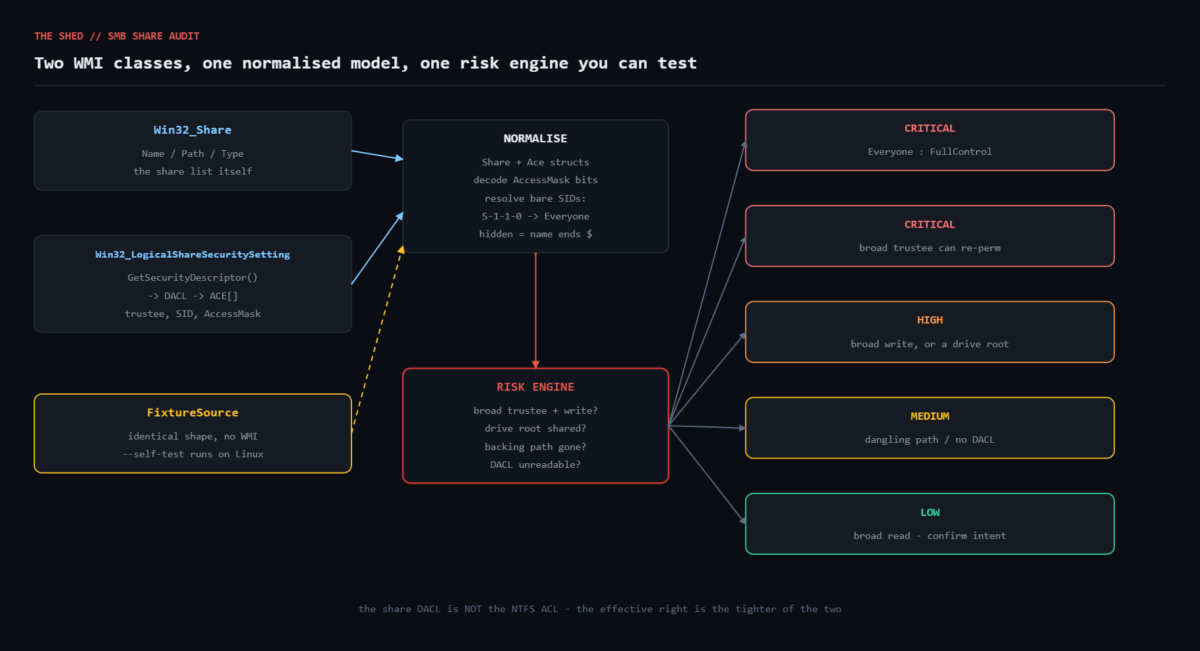
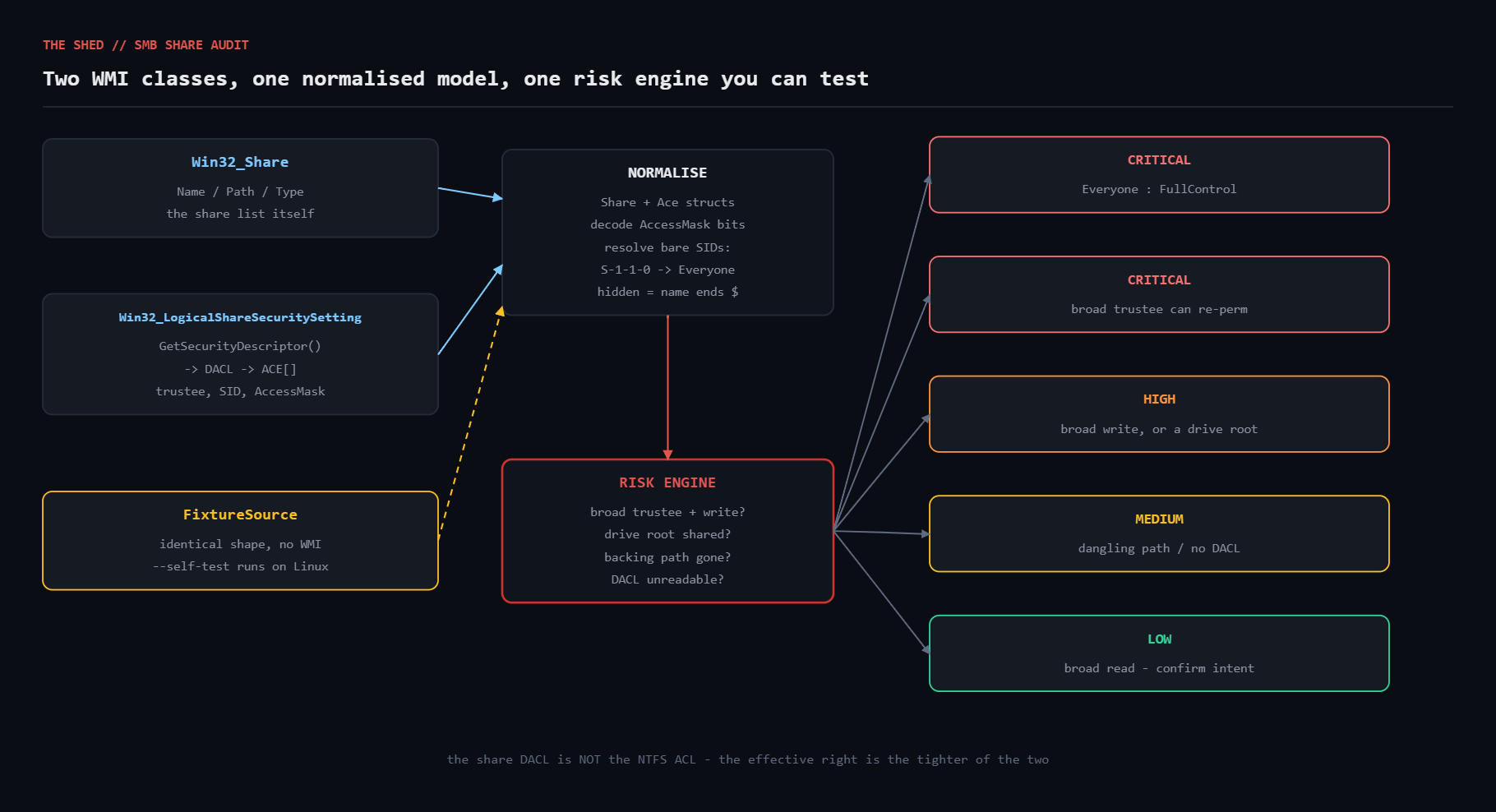
Windows keeps two access control lists on every share and hides them on different tabs. The one nobody looks at is usually Everyone / Full Control. Here is a Ruby WMI auditor that finds them — and a pattern for testing Windows-only code on a Linux CI box.
Step through the build below:
File shares are where temporary access grants go to die. Someone creates \\FS01\ProjectX for a two-week migration, ticks Everyone / Full Control because the deadline is tomorrow, and five years later it is still there with 400 GB of finance data behind it. Nothing in Windows ever reminds you.
The trap that makes this worse: Windows has two access control lists on every share, and the GUI puts them on different tabs. The share DACL lives in the Sharing tab — often left wide open because “NTFS will catch it”. The NTFS ACL lives in the Security tab.
The effective permission is the tighter of the two, which is why a wide-open share DACL usually causes no visible problem — right up until someone loosens the NTFS side. This script audits the share DACL specifically, because it is the one that gets ignored.
smb_share_audit.rb
#!/usr/bin/env ruby
# frozen_string_literal: true
#
# smb_share_audit.rb -- SMB share and share-permission auditor for Windows
#
# File shares are where "temporary" access grants go to die. Someone creates
# \\FS01\ProjectX for a two-week migration, ticks Everyone / Full Control
# because the deadline is tomorrow, and five years later it is still there with
# 400 GB of finance data behind it. Nothing in Windows reminds you.
#
# This script walks every non-hidden share on a host via WMI, pulls the share
# level DACL (which is a separate, and usually far looser, ACL from the NTFS
# permissions on the folder underneath), decodes the access mask, and flags the
# dangerous combinations: broad trustees with write or full control, shares
# pointing at the root of a drive, shares whose backing path no longer exists.
#
# WMI classes used:
#   Win32_Share                        -- the share list
#   Win32_LogicalShareSecuritySetting  -- GetSecurityDescriptor() -> Win32_SecurityDescriptor
#
# TESTING NOTE: win32ole only exists on Windows, so the WMI access is isolated
# behind a source object. `--self-test` swaps in a fixture source and runs the
# whole classification pipeline with no WMI at all, which means the risk logic
# is verifiable on any platform (including CI on Linux). See the README.
#
# Exit codes:
#   0  no findings at or above the fail threshold
#   1  findings present
#   2  the audit could not run
#
# Usage (on Windows):
#   ruby smb_share_audit.rb
#   ruby smb_share_audit.rb --host FS01 --json
#   ruby smb_share_audit.rb --include-hidden --fail-on medium
#
# Usage (anywhere):
#   ruby smb_share_audit.rb --self-test
#
# Ruby >= 2.7 (Windows build with win32ole for live mode), stdlib only.

require 'json'
require 'optparse'

module SmbShareAudit
  VERSION = '1.0.0'

  # ---------------------------------------------------------------------------
  # Windows constants. These are the values WMI actually hands back, so they
  # are declared once here rather than as magic numbers in the logic.
  # ---------------------------------------------------------------------------
  module Win
    # Win32_Share.Type
    SHARE_TYPES = {
      0 => 'Disk Drive', 1 => 'Print Queue', 2 => 'Device', 3 => 'IPC',
      2_147_483_648 => 'Disk Drive Admin', 2_147_483_649 => 'Print Queue Admin',
      2_147_483_650 => 'Device Admin', 2_147_483_651 => 'IPC Admin'
    }.freeze

    # ACE types
    ACCESS_ALLOWED = 0
    ACCESS_DENIED  = 1

    # Share-level access mask bits that matter for this audit.
    FILE_READ_DATA    = 0x00000001
    FILE_WRITE_DATA   = 0x00000002
    FILE_APPEND_DATA  = 0x00000004
    FILE_EXECUTE      = 0x00000020
    DELETE            = 0x00010000
    WRITE_DAC         = 0x00040000  # can rewrite the ACL itself
    WRITE_OWNER       = 0x00080000  # can take ownership
    GENERIC_ALL       = 0x10000000
    FULL_CONTROL      = 0x001F01FF

    WRITE_BITS = FILE_WRITE_DATA | FILE_APPEND_DATA | DELETE
    OWN_BITS   = WRITE_DAC | WRITE_OWNER | GENERIC_ALL

    # Trustees that effectively mean "anyone who can reach the share".
    BROAD_TRUSTEES = [
      'Everyone', 'ANONYMOUS LOGON', 'Authenticated Users', 'Users',
      'Domain Users', 'INTERACTIVE', 'NETWORK', 'Guests', 'Guest'
    ].freeze

    # Well-known SIDs, for hosts where WMI returns a SID with no resolvable name
    # (deleted accounts, broken trusts, offline DCs).
    WELL_KNOWN_SIDS = {
      'S-1-1-0' => 'Everyone', 'S-1-5-7' => 'ANONYMOUS LOGON',
      'S-1-5-11' => 'Authenticated Users', 'S-1-5-32-545' => 'Users',
      'S-1-5-32-546' => 'Guests', 'S-1-5-32-544' => 'Administrators',
      'S-1-5-4' => 'INTERACTIVE', 'S-1-5-2' => 'NETWORK'
    }.freeze

    def self.decode_mask(mask)
      return ['FullControl'] if (mask & FULL_CONTROL) == FULL_CONTROL || (mask & GENERIC_ALL) != 0

      rights = []
      rights << 'Read'         if (mask & FILE_READ_DATA)  != 0
      rights << 'Write'        if (mask & FILE_WRITE_DATA) != 0
      rights << 'Append'       if (mask & FILE_APPEND_DATA) != 0
      rights << 'Execute'      if (mask & FILE_EXECUTE)    != 0
      rights << 'Delete'       if (mask & DELETE)          != 0
      rights << 'ChangePerms'  if (mask & WRITE_DAC)       != 0
      rights << 'TakeOwnership' if (mask & WRITE_OWNER)    != 0
      rights.empty? ? [format('0x%08X', mask)] : rights
    end
  end

  # ---------------------------------------------------------------------------
  # Normalised data model -- identical shape whether it came from WMI or a fixture.
  # ---------------------------------------------------------------------------
  Ace = Struct.new(:trustee, :domain, :sid, :mask, :ace_type, keyword_init: true) do
    def allow?  = ace_type == Win::ACCESS_ALLOWED
    def rights  = Win.decode_mask(mask.to_i)

    # Resolve a bare SID to its well-known name so "S-1-1-0" does not silently
    # slip past the broad-trustee check.
    def effective_name
      return trustee unless trustee.nil? || trustee.empty?

      Win::WELL_KNOWN_SIDS.fetch(sid.to_s, sid.to_s)
    end

    def broad?        = Win::BROAD_TRUSTEES.include?(effective_name)
    def full_control? = rights.include?('FullControl')
    def writable?     = full_control? || (mask.to_i & Win::WRITE_BITS) != 0
    def ownership?    = (mask.to_i & Win::OWN_BITS) != 0

    def display
      who = domain.to_s.empty? ? effective_name : "#{domain}\\#{effective_name}"
      "#{allow? ? 'Allow' : 'Deny '} #{who} : #{rights.join(',')}"
    end
  end

  Share = Struct.new(:name, :path, :type, :description, :hidden, :aces,
                     :path_exists, :error, keyword_init: true) do
    def type_name = Win::SHARE_TYPES.fetch(type.to_i, "Unknown(#{type})")

    # C:\ or D:\ -- sharing a whole volume is almost never intentional.
    def drive_root? = !path.nil? && path.match?(/\A[A-Za-z]:\\?\z/)
  end

  # ---------------------------------------------------------------------------
  # Source 1: live WMI. Only this class touches win32ole.
  # ---------------------------------------------------------------------------
  class WmiSource
    def initialize(host: '.')
      require 'win32ole'
      @host = host
      @wmi = WIN32OLE.connect("winmgmts://#{host}/root/cimv2")
    rescue LoadError
      raise "win32ole is unavailable -- this mode only runs on Windows. Try --self-test."
    rescue WIN32OLERuntimeError => e
      raise "cannot reach WMI on #{host}: #{e.message}"
    end

    def name = "WMI://#{@host}"

    def shares
      @wmi.ExecQuery('SELECT * FROM Win32_Share').map do |s|
        name = s.Name.to_s
        Share.new(
          name: name,
          path: s.Path.to_s,
          type: s.Type.to_i,
          description: s.Description.to_s,
          hidden: name.end_with?('$'),
          path_exists: s.Path.to_s.empty? ? true : Dir.exist?(s.Path.to_s),
          aces: security_for(name),
          error: nil
        )
      end
    rescue WIN32OLERuntimeError => e
      raise "share enumeration failed: #{e.message}"
    end

    private

    # The share DACL lives on a different class from the share itself. If the
    # share has no explicit descriptor WMI returns a non-zero status, which we
    # surface rather than silently reporting "no permissions".
    def security_for(share_name)
      setting = @wmi.ExecQuery(
        "SELECT * FROM Win32_LogicalShareSecuritySetting WHERE Name='#{share_name.gsub("'", "''")}'"
      ).each.first
      return [] if setting.nil?

      sd = nil
      status = setting.GetSecurityDescriptor(sd)
      return [] unless status.to_i.zero?

      descriptor = setting.GetSecurityDescriptor_(nil) rescue nil
      dacl = extract_dacl(descriptor, setting)
      return [] if dacl.nil?

      dacl.map do |ace|
        trustee = ace.Trustee
        Ace.new(trustee: trustee.Name.to_s, domain: trustee.Domain.to_s,
                sid: trustee.SIDString.to_s, mask: ace.AccessMask.to_i,
                ace_type: ace.AceType.to_i)
      end
    rescue WIN32OLERuntimeError, NoMethodError
      []
    end

    # WMI out-parameters are awkward from Ruby: depending on the ruby/win32ole
    # build the descriptor arrives as a return value or via the ExecMethod_
    # path. Try both rather than assuming.
    def extract_dacl(descriptor, setting)
      return descriptor.DACL if descriptor.respond_to?(:DACL)

      out = setting.ExecMethod_('GetSecurityDescriptor')
      out.Descriptor.DACL
    rescue StandardError
      nil
    end
  end

  # ---------------------------------------------------------------------------
  # Source 2: fixtures. Lets the whole risk pipeline be exercised off-Windows.
  # ---------------------------------------------------------------------------
  class FixtureSource
    def initialize(data) = @data = data
    def name = 'fixture'

    def shares
      @data.map do |s|
        Share.new(
          name: s[:name], path: s[:path], type: s[:type] || 0,
          description: s[:description].to_s,
          hidden: s[:name].to_s.end_with?('$'),
          path_exists: s.fetch(:path_exists, true),
          error: nil,
          aces: Array(s[:aces]).map do |a|
            Ace.new(trustee: a[:trustee], domain: a[:domain].to_s, sid: a[:sid].to_s,
                    mask: a[:mask], ace_type: a[:ace_type] || Win::ACCESS_ALLOWED)
          end
        )
      end
    end

    # A deliberately nasty but entirely realistic file server.
    def self.sample
      new([
        { name: 'Finance', path: 'D:\\Finance', description: 'Finance department',
          aces: [
            { trustee: 'Everyone', sid: 'S-1-1-0', mask: Win::FULL_CONTROL },
            { trustee: 'Domain Admins', domain: 'CORP', sid: 'S-1-5-21-1-512',
              mask: Win::FULL_CONTROL }
          ] },
        { name: 'Public', path: 'D:\\Public', description: 'Scratch space',
          aces: [
            { trustee: 'Authenticated Users', sid: 'S-1-5-11',
              mask: Win::FILE_READ_DATA | Win::FILE_WRITE_DATA | Win::FILE_EXECUTE }
          ] },
        { name: 'Reports', path: 'D:\\Reports', description: 'Read-only reporting drop',
          aces: [
            { trustee: 'Domain Users', domain: 'CORP', sid: 'S-1-5-21-1-513',
              mask: Win::FILE_READ_DATA | Win::FILE_EXECUTE },
            { trustee: 'Backup Operators', domain: 'BUILTIN', sid: 'S-1-5-32-551',
              mask: Win::FILE_READ_DATA }
          ] },
        { name: 'Wholedisk', path: 'E:\\', description: 'shared for the 2019 migration',
          aces: [
            { trustee: 'svc_migrate', domain: 'CORP', sid: 'S-1-5-21-1-1104',
              mask: Win::FULL_CONTROL }
          ] },
        { name: 'OldProject', path: 'D:\\Projects\\Gone', description: 'decommissioned',
          path_exists: false,
          aces: [
            { trustee: '', sid: 'S-1-1-0', mask: Win::FILE_READ_DATA }
          ] },
        { name: 'ADMIN$', path: 'C:\\Windows', description: 'Remote Admin',
          type: 2_147_483_648, aces: [] }
      ])
    end
  end

  # ---------------------------------------------------------------------------
  # Risk rules. Each returns a Finding or nil; adding a rule is a one-method change.
  # ---------------------------------------------------------------------------
  Finding = Struct.new(:severity, :share, :path, :rule, :detail, keyword_init: true)

  class RiskEngine
    SEVERITIES = %w[low medium high critical].freeze

    def evaluate(share)
      findings = []
      findings.concat(broad_trustee_findings(share))
      findings << drive_root_finding(share)
      findings << missing_path_finding(share)
      findings << no_dacl_finding(share)
      findings.compact
    end

    private

    # The headline rule: a broad trustee with anything beyond read.
    def broad_trustee_findings(share)
      share.aces.select { |a| a.allow? && a.broad? }.filter_map do |ace|
        who = ace.effective_name

        if ace.full_control?
          finding('critical', share, 'broad_full_control',
                  "#{who} has FullControl on the share DACL")
        elsif ace.ownership?
          finding('critical', share, 'broad_can_reperm',
                  "#{who} can change permissions or take ownership (#{ace.rights.join(',')})")
        elsif ace.writable?
          finding('high', share, 'broad_write',
                  "#{who} has write access (#{ace.rights.join(',')})")
        elsif who == 'ANONYMOUS LOGON'
          finding('high', share, 'anonymous_read',
                  'ANONYMOUS LOGON can read this share')
        else
          finding('low', share, 'broad_read',
                  "#{who} has read access -- confirm this is intended")
        end
      end
    end

    def drive_root_finding(share)
      return nil unless share.drive_root?
      return nil if share.hidden # C$/D$ are the built-in admin shares

      finding('high', share, 'drive_root_share',
              "share exposes the root of #{share.path}, not a subfolder")
    end

    def missing_path_finding(share)
      return nil if share.path_exists
      return nil if share.path.to_s.empty?

      finding('medium', share, 'dangling_path',
              "backing path #{share.path} does not exist -- stale share definition")
    end

    # An empty DACL on a disk share is not "locked down", it usually means the
    # descriptor could not be read, which is itself worth knowing about.
    def no_dacl_finding(share)
      return nil unless share.type.to_i.zero?
      return nil unless share.aces.empty?

      finding('medium', share, 'no_share_dacl',
              'no share-level DACL was returned; permissions may be inherited or unreadable')
    end

    def finding(sev, share, rule, detail)
      Finding.new(severity: sev, share: share.name, path: share.path,
                  rule: rule, detail: detail)
    end
  end

  # ---------------------------------------------------------------------------
  # Output
  # ---------------------------------------------------------------------------
  class Report
    RANK = { 'critical' => 0, 'high' => 1, 'medium' => 2, 'low' => 3 }.freeze
    MARK = { 'critical' => '[CRIT]', 'high' => '[HIGH]', 'medium' => '[MED ]',
             'low' => '[LOW ]' }.freeze

    def initialize(shares, findings, source)
      @shares = shares
      @findings = findings
      @source = source
    end

    def at_or_above(threshold)
      floor = RANK.fetch(threshold, 3)
      @findings.select { |f| RANK.fetch(f.severity, 9) <= floor }
    end

    def text
      w = 76
      out = []
      out << '=' * w
      out << "  SMB SHARE AUDIT   source=#{@source}   #{Time.now.strftime('%Y-%m-%d %H:%M:%S')}"
      out << '=' * w
      out << "  #{@shares.size} share(s) enumerated, #{@findings.size} finding(s)"
      out << ''

      @shares.each do |s|
        flag = s.hidden ? ' (hidden)' : ''
        out << "  #{s.name}#{flag}  ->  #{s.path.to_s.empty? ? '-' : s.path}   [#{s.type_name}]"
        if s.aces.empty?
          out << '      (no share-level ACEs returned)'
        else
          s.aces.each { |a| out << "      #{a.display}" }
        end
        mine = @findings.select { |f| f.share == s.name }
        mine.sort_by { |f| RANK.fetch(f.severity, 9) }.each do |f|
          out << "      #{MARK[f.severity]} #{f.rule}: #{f.detail}"
        end
        out << ''
      end

      out << '-' * w
      out << "  #{summary}"
      out << '=' * w
      out.join("\n")
    end

    def json
      JSON.pretty_generate(
        source: @source,
        generated_at: Time.now.utc.strftime('%Y-%m-%dT%H:%M:%SZ'),
        summary: counts,
        shares: @shares.map do |s|
          { name: s.name, path: s.path, type: s.type_name, hidden: s.hidden,
            aces: s.aces.map { |a| { trustee: a.effective_name, domain: a.domain,
                                     sid: a.sid, rights: a.rights, allow: a.allow? } } }
        end,
        findings: @findings.map(&:to_h)
      )
    end

    def counts = @findings.group_by(&:severity).transform_values(&:size)

    private

    def summary
      c = counts
      "#{@shares.size} shares | " + RANK.keys.map { |s| "#{s}=#{c.fetch(s, 0)}" }.join(' ')
    end
  end

  # ---------------------------------------------------------------------------
  # Self-test: proves the risk pipeline without WMI.
  # ---------------------------------------------------------------------------
  def self.self_test
    shares = FixtureSource.sample.shares
    findings = shares.flat_map { |s| RiskEngine.new.evaluate(s) }
    report = Report.new(shares, findings, 'fixture (self-test)')
    puts report.text

    expectations = [
      ['Finance flagged critical for Everyone/FullControl',
       findings.any? { |f| f.share == 'Finance' && f.rule == 'broad_full_control' }],
      ['Public flagged high for Authenticated Users write',
       findings.any? { |f| f.share == 'Public' && f.rule == 'broad_write' }],
      ['Reports NOT flagged above low (read-only by design)',
       findings.select { |f| f.share == 'Reports' }.all? { |f| f.severity == 'low' }],
      ['Wholedisk flagged for sharing a drive root',
       findings.any? { |f| f.share == 'Wholedisk' && f.rule == 'drive_root_share' }],
      ['OldProject flagged for a dangling backing path',
       findings.any? { |f| f.share == 'OldProject' && f.rule == 'dangling_path' }],
      ['Bare SID S-1-1-0 resolved to Everyone',
       shares.find { |s| s.name == 'OldProject' }.aces.first.effective_name == 'Everyone'],
      ['ADMIN$ (hidden admin share) not flagged as a drive-root share',
       findings.none? { |f| f.share == 'ADMIN$' && f.rule == 'drive_root_share' }],
      ['FULL_CONTROL mask decodes to FullControl',
       Win.decode_mask(Win::FULL_CONTROL) == ['FullControl']],
      ['Read+Execute mask decodes without write rights',
       Win.decode_mask(Win::FILE_READ_DATA | Win::FILE_EXECUTE) == %w[Read Execute]]
    ]

    puts "\nSELF-TEST"
    puts '-' * 60
    passed = 0
    expectations.each do |label, ok|
      puts "  #{ok ? 'ok  ' : 'FAIL'}  #{label}"
      passed += 1 if ok
    end
    puts '-' * 60
    puts "  #{passed}/#{expectations.size} assertions passed"
    passed == expectations.size
  end
end

# -----------------------------------------------------------------------------
# CLI
# -----------------------------------------------------------------------------
if __FILE__ == $PROGRAM_NAME
  opts = { host: '.', format: :text, fail_on: 'high', include_hidden: false }

  OptionParser.new do |o|
    o.banner = 'Usage: smb_share_audit.rb [options]'
    o.on('-H', '--host NAME', 'audit a remote host via WMI') { |v| opts[:host] = v }
    o.on('-j', '--json', 'emit JSON')                        { opts[:format] = :json }
    o.on('--include-hidden', 'include $-suffixed admin shares') { opts[:include_hidden] = true }
    o.on('--fail-on SEV', %w[low medium high critical],
         'exit 1 at or above this severity (default high)') { |v| opts[:fail_on] = v }
    o.on('--self-test', 'run the risk engine against fixtures (no WMI)') { opts[:self_test] = true }
    o.on('-v', '--version') { puts "smb_share_audit #{SmbShareAudit::VERSION}"; exit 0 }
    o.on('-h', '--help')    { puts o; exit 0 }
  end.parse!

  begin
    if opts[:self_test]
      exit(SmbShareAudit.self_test ? 0 : 1)
    end

    source = SmbShareAudit::WmiSource.new(host: opts[:host])
    shares = source.shares
    shares = shares.reject(&:hidden) unless opts[:include_hidden]

    engine = SmbShareAudit::RiskEngine.new
    findings = shares.flat_map { |s| engine.evaluate(s) }
    report = SmbShareAudit::Report.new(shares, findings, source.name)

    puts opts[:format] == :json ? report.json : report.text
    exit(report.at_or_above(opts[:fail_on]).empty? ? 0 : 1)
  rescue StandardError => e
    warn "smb_share_audit: #{e.message}"
    exit 2
  end
end
Two WMI classes, not one. Win32_Share gives you the share list. The permissions live on Win32_LogicalShareSecuritySetting, behind a GetSecurityDescriptor() call with an out-parameter — genuinely awkward from Ruby, and the script tries both the return-value and ExecMethod_ paths rather than assuming which build you are on.
WRITE_DAC deserves its own severity. A trustee holding WRITE_DAC or WRITE_OWNER can grant themselves anything else, so “they only have WRITE_DAC” is not a mitigation — it is full control with one extra step.
Bare SIDs still count. When an account is deleted or a trust breaks, WMI returns an ACE with an empty Trustee.Name and only a SID. A naive audit skips those, which is exactly backwards: an unresolvable S-1-1-0 is still Everyone.
Testing Windows-only code. win32ole does not exist off Windows, so all WMI access is isolated in WmiSource and a FixtureSource produces the identical Share/Ace shape. –self-test runs the whole classification pipeline against a deliberately nasty fixture file server on any platform, asserting nine properties of the result.
$ ruby smb_share_audit.rb –self-test
$ ruby smb_share_audit.rb --self-test
============================================================================
  SMB SHARE AUDIT   source=fixture (self-test)   2026-08-18 14:41:05
============================================================================
  6 share(s) enumerated, 6 finding(s)

  Finance  ->  D:\Finance   [Disk Drive]
      Allow Everyone : FullControl
      Allow CORP\Domain Admins : FullControl
      [CRIT] broad_full_control: Everyone has FullControl on the share DACL

  Public  ->  D:\Public   [Disk Drive]
      Allow Authenticated Users : Read,Write,Execute
      [HIGH] broad_write: Authenticated Users has write access (Read,Write,Execute)

  Reports  ->  D:\Reports   [Disk Drive]
      Allow CORP\Domain Users : Read,Execute
      Allow BUILTIN\Backup Operators : Read
      [LOW ] broad_read: Domain Users has read access -- confirm this is intended

  Wholedisk  ->  E:\   [Disk Drive]
      Allow CORP\svc_migrate : FullControl
      [HIGH] drive_root_share: share exposes the root of E:\, not a subfolder

  OldProject  ->  D:\Projects\Gone   [Disk Drive]
      Allow Everyone : Read
      [MED ] dangling_path: backing path D:\Projects\Gone does not exist -- stale share definition
      [LOW ] broad_read: Everyone has read access -- confirm this is intended

  ADMIN$ (hidden)  ->  C:\Windows   [Disk Drive Admin]
      (no share-level ACEs returned)

----------------------------------------------------------------------------
  6 shares | critical=1 high=2 medium=1 low=2
============================================================================

SELF-TEST
------------------------------------------------------------
  ok    Finance flagged critical for Everyone/FullControl
  ok    Public flagged high for Authenticated Users write
  ok    Reports NOT flagged above low (read-only by design)
  ok    Wholedisk flagged for sharing a drive root
  ok    OldProject flagged for a dangling backing path
  ok    Bare SID S-1-1-0 resolved to Everyone
  ok    ADMIN$ (hidden admin share) not flagged as a drive-root share
  ok    FULL_CONTROL mask decodes to FullControl
  ok    Read+Execute mask decodes without write rights
------------------------------------------------------------
  9/9 assertions passed
Full script, baseline files and README on GitHub: ruby-devops-toolkit/smb-share-audit
What you need
- Ruby ≥ 2.7, and for live mode a Windows build (RubyInstaller) —
win32oleships with it. - No gems. Stdlib only:
win32ole,json,optparse. - Windows for live mode.
--self-testruns anywhere, including Linux CI. - Local Administrator to read share security descriptors. Remote auditing additionally needs DCOM/WMI reachable and admin rights on the target.
smb_share_audit.rb
#!/usr/bin/env ruby
# frozen_string_literal: true
#
# smb_share_audit.rb -- SMB share and share-permission auditor for Windows
#
# File shares are where "temporary" access grants go to die. Someone creates
# \\FS01\ProjectX for a two-week migration, ticks Everyone / Full Control
# because the deadline is tomorrow, and five years later it is still there with
# 400 GB of finance data behind it. Nothing in Windows reminds you.
#
# This script walks every non-hidden share on a host via WMI, pulls the share
# level DACL (which is a separate, and usually far looser, ACL from the NTFS
# permissions on the folder underneath), decodes the access mask, and flags the
# dangerous combinations: broad trustees with write or full control, shares
# pointing at the root of a drive, shares whose backing path no longer exists.
#
# WMI classes used:
#   Win32_Share                        -- the share list
#   Win32_LogicalShareSecuritySetting  -- GetSecurityDescriptor() -> Win32_SecurityDescriptor
#
# TESTING NOTE: win32ole only exists on Windows, so the WMI access is isolated
# behind a source object. `--self-test` swaps in a fixture source and runs the
# whole classification pipeline with no WMI at all, which means the risk logic
# is verifiable on any platform (including CI on Linux). See the README.
#
# Exit codes:
#   0  no findings at or above the fail threshold
#   1  findings present
#   2  the audit could not run
#
# Usage (on Windows):
#   ruby smb_share_audit.rb
#   ruby smb_share_audit.rb --host FS01 --json
#   ruby smb_share_audit.rb --include-hidden --fail-on medium
#
# Usage (anywhere):
#   ruby smb_share_audit.rb --self-test
#
# Ruby >= 2.7 (Windows build with win32ole for live mode), stdlib only.

require 'json'
require 'optparse'

module SmbShareAudit
  VERSION = '1.0.0'

  # ---------------------------------------------------------------------------
  # Windows constants. These are the values WMI actually hands back, so they
  # are declared once here rather than as magic numbers in the logic.
  # ---------------------------------------------------------------------------
  module Win
    # Win32_Share.Type
    SHARE_TYPES = {
      0 => 'Disk Drive', 1 => 'Print Queue', 2 => 'Device', 3 => 'IPC',
      2_147_483_648 => 'Disk Drive Admin', 2_147_483_649 => 'Print Queue Admin',
      2_147_483_650 => 'Device Admin', 2_147_483_651 => 'IPC Admin'
    }.freeze

    # ACE types
    ACCESS_ALLOWED = 0
    ACCESS_DENIED  = 1

    # Share-level access mask bits that matter for this audit.
    FILE_READ_DATA    = 0x00000001
    FILE_WRITE_DATA   = 0x00000002
    FILE_APPEND_DATA  = 0x00000004
    FILE_EXECUTE      = 0x00000020
    DELETE            = 0x00010000
    WRITE_DAC         = 0x00040000  # can rewrite the ACL itself
    WRITE_OWNER       = 0x00080000  # can take ownership
    GENERIC_ALL       = 0x10000000
    FULL_CONTROL      = 0x001F01FF

    WRITE_BITS = FILE_WRITE_DATA | FILE_APPEND_DATA | DELETE
    OWN_BITS   = WRITE_DAC | WRITE_OWNER | GENERIC_ALL

    # Trustees that effectively mean "anyone who can reach the share".
    BROAD_TRUSTEES = [
      'Everyone', 'ANONYMOUS LOGON', 'Authenticated Users', 'Users',
      'Domain Users', 'INTERACTIVE', 'NETWORK', 'Guests', 'Guest'
    ].freeze

    # Well-known SIDs, for hosts where WMI returns a SID with no resolvable name
    # (deleted accounts, broken trusts, offline DCs).
    WELL_KNOWN_SIDS = {
      'S-1-1-0' => 'Everyone', 'S-1-5-7' => 'ANONYMOUS LOGON',
      'S-1-5-11' => 'Authenticated Users', 'S-1-5-32-545' => 'Users',
      'S-1-5-32-546' => 'Guests', 'S-1-5-32-544' => 'Administrators',
      'S-1-5-4' => 'INTERACTIVE', 'S-1-5-2' => 'NETWORK'
    }.freeze

    def self.decode_mask(mask)
      return ['FullControl'] if (mask & FULL_CONTROL) == FULL_CONTROL || (mask & GENERIC_ALL) != 0

      rights = []
      rights << 'Read'         if (mask & FILE_READ_DATA)  != 0
      rights << 'Write'        if (mask & FILE_WRITE_DATA) != 0
      rights << 'Append'       if (mask & FILE_APPEND_DATA) != 0
      rights << 'Execute'      if (mask & FILE_EXECUTE)    != 0
      rights << 'Delete'       if (mask & DELETE)          != 0
      rights << 'ChangePerms'  if (mask & WRITE_DAC)       != 0
      rights << 'TakeOwnership' if (mask & WRITE_OWNER)    != 0
      rights.empty? ? [format('0x%08X', mask)] : rights
    end
  end

  # ---------------------------------------------------------------------------
  # Normalised data model -- identical shape whether it came from WMI or a fixture.
  # ---------------------------------------------------------------------------
  Ace = Struct.new(:trustee, :domain, :sid, :mask, :ace_type, keyword_init: true) do
    def allow?  = ace_type == Win::ACCESS_ALLOWED
    def rights  = Win.decode_mask(mask.to_i)

    # Resolve a bare SID to its well-known name so "S-1-1-0" does not silently
    # slip past the broad-trustee check.
    def effective_name
      return trustee unless trustee.nil? || trustee.empty?

      Win::WELL_KNOWN_SIDS.fetch(sid.to_s, sid.to_s)
    end

    def broad?        = Win::BROAD_TRUSTEES.include?(effective_name)
    def full_control? = rights.include?('FullControl')
    def writable?     = full_control? || (mask.to_i & Win::WRITE_BITS) != 0
    def ownership?    = (mask.to_i & Win::OWN_BITS) != 0

    def display
      who = domain.to_s.empty? ? effective_name : "#{domain}\\#{effective_name}"
      "#{allow? ? 'Allow' : 'Deny '} #{who} : #{rights.join(',')}"
    end
  end

  Share = Struct.new(:name, :path, :type, :description, :hidden, :aces,
                     :path_exists, :error, keyword_init: true) do
    def type_name = Win::SHARE_TYPES.fetch(type.to_i, "Unknown(#{type})")

    # C:\ or D:\ -- sharing a whole volume is almost never intentional.
    def drive_root? = !path.nil? && path.match?(/\A[A-Za-z]:\\?\z/)
  end

  # ---------------------------------------------------------------------------
  # Source 1: live WMI. Only this class touches win32ole.
  # ---------------------------------------------------------------------------
  class WmiSource
    def initialize(host: '.')
      require 'win32ole'
      @host = host
      @wmi = WIN32OLE.connect("winmgmts://#{host}/root/cimv2")
    rescue LoadError
      raise "win32ole is unavailable -- this mode only runs on Windows. Try --self-test."
    rescue WIN32OLERuntimeError => e
      raise "cannot reach WMI on #{host}: #{e.message}"
    end

    def name = "WMI://#{@host}"

    def shares
      @wmi.ExecQuery('SELECT * FROM Win32_Share').map do |s|
        name = s.Name.to_s
        Share.new(
          name: name,
          path: s.Path.to_s,
          type: s.Type.to_i,
          description: s.Description.to_s,
          hidden: name.end_with?('$'),
          path_exists: s.Path.to_s.empty? ? true : Dir.exist?(s.Path.to_s),
          aces: security_for(name),
          error: nil
        )
      end
    rescue WIN32OLERuntimeError => e
      raise "share enumeration failed: #{e.message}"
    end

    private

    # The share DACL lives on a different class from the share itself. If the
    # share has no explicit descriptor WMI returns a non-zero status, which we
    # surface rather than silently reporting "no permissions".
    def security_for(share_name)
      setting = @wmi.ExecQuery(
        "SELECT * FROM Win32_LogicalShareSecuritySetting WHERE Name='#{share_name.gsub("'", "''")}'"
      ).each.first
      return [] if setting.nil?

      sd = nil
      status = setting.GetSecurityDescriptor(sd)
      return [] unless status.to_i.zero?

      descriptor = setting.GetSecurityDescriptor_(nil) rescue nil
      dacl = extract_dacl(descriptor, setting)
      return [] if dacl.nil?

      dacl.map do |ace|
        trustee = ace.Trustee
        Ace.new(trustee: trustee.Name.to_s, domain: trustee.Domain.to_s,
                sid: trustee.SIDString.to_s, mask: ace.AccessMask.to_i,
                ace_type: ace.AceType.to_i)
      end
    rescue WIN32OLERuntimeError, NoMethodError
      []
    end

    # WMI out-parameters are awkward from Ruby: depending on the ruby/win32ole
    # build the descriptor arrives as a return value or via the ExecMethod_
    # path. Try both rather than assuming.
    def extract_dacl(descriptor, setting)
      return descriptor.DACL if descriptor.respond_to?(:DACL)

      out = setting.ExecMethod_('GetSecurityDescriptor')
      out.Descriptor.DACL
    rescue StandardError
      nil
    end
  end

  # ---------------------------------------------------------------------------
  # Source 2: fixtures. Lets the whole risk pipeline be exercised off-Windows.
  # ---------------------------------------------------------------------------
  class FixtureSource
    def initialize(data) = @data = data
    def name = 'fixture'

    def shares
      @data.map do |s|
        Share.new(
          name: s[:name], path: s[:path], type: s[:type] || 0,
          description: s[:description].to_s,
          hidden: s[:name].to_s.end_with?('$'),
          path_exists: s.fetch(:path_exists, true),
          error: nil,
          aces: Array(s[:aces]).map do |a|
            Ace.new(trustee: a[:trustee], domain: a[:domain].to_s, sid: a[:sid].to_s,
                    mask: a[:mask], ace_type: a[:ace_type] || Win::ACCESS_ALLOWED)
          end
        )
      end
    end

    # A deliberately nasty but entirely realistic file server.
    def self.sample
      new([
        { name: 'Finance', path: 'D:\\Finance', description: 'Finance department',
          aces: [
            { trustee: 'Everyone', sid: 'S-1-1-0', mask: Win::FULL_CONTROL },
            { trustee: 'Domain Admins', domain: 'CORP', sid: 'S-1-5-21-1-512',
              mask: Win::FULL_CONTROL }
          ] },
        { name: 'Public', path: 'D:\\Public', description: 'Scratch space',
          aces: [
            { trustee: 'Authenticated Users', sid: 'S-1-5-11',
              mask: Win::FILE_READ_DATA | Win::FILE_WRITE_DATA | Win::FILE_EXECUTE }
          ] },
        { name: 'Reports', path: 'D:\\Reports', description: 'Read-only reporting drop',
          aces: [
            { trustee: 'Domain Users', domain: 'CORP', sid: 'S-1-5-21-1-513',
              mask: Win::FILE_READ_DATA | Win::FILE_EXECUTE },
            { trustee: 'Backup Operators', domain: 'BUILTIN', sid: 'S-1-5-32-551',
              mask: Win::FILE_READ_DATA }
          ] },
        { name: 'Wholedisk', path: 'E:\\', description: 'shared for the 2019 migration',
          aces: [
            { trustee: 'svc_migrate', domain: 'CORP', sid: 'S-1-5-21-1-1104',
              mask: Win::FULL_CONTROL }
          ] },
        { name: 'OldProject', path: 'D:\\Projects\\Gone', description: 'decommissioned',
          path_exists: false,
          aces: [
            { trustee: '', sid: 'S-1-1-0', mask: Win::FILE_READ_DATA }
          ] },
        { name: 'ADMIN$', path: 'C:\\Windows', description: 'Remote Admin',
          type: 2_147_483_648, aces: [] }
      ])
    end
  end

  # ---------------------------------------------------------------------------
  # Risk rules. Each returns a Finding or nil; adding a rule is a one-method change.
  # ---------------------------------------------------------------------------
  Finding = Struct.new(:severity, :share, :path, :rule, :detail, keyword_init: true)

  class RiskEngine
    SEVERITIES = %w[low medium high critical].freeze

    def evaluate(share)
      findings = []
      findings.concat(broad_trustee_findings(share))
      findings << drive_root_finding(share)
      findings << missing_path_finding(share)
      findings << no_dacl_finding(share)
      findings.compact
    end

    private

    # The headline rule: a broad trustee with anything beyond read.
    def broad_trustee_findings(share)
      share.aces.select { |a| a.allow? && a.broad? }.filter_map do |ace|
        who = ace.effective_name

        if ace.full_control?
          finding('critical', share, 'broad_full_control',
                  "#{who} has FullControl on the share DACL")
        elsif ace.ownership?
          finding('critical', share, 'broad_can_reperm',
                  "#{who} can change permissions or take ownership (#{ace.rights.join(',')})")
        elsif ace.writable?
          finding('high', share, 'broad_write',
                  "#{who} has write access (#{ace.rights.join(',')})")
        elsif who == 'ANONYMOUS LOGON'
          finding('high', share, 'anonymous_read',
                  'ANONYMOUS LOGON can read this share')
        else
          finding('low', share, 'broad_read',
                  "#{who} has read access -- confirm this is intended")
        end
      end
    end

    def drive_root_finding(share)
      return nil unless share.drive_root?
      return nil if share.hidden # C$/D$ are the built-in admin shares

      finding('high', share, 'drive_root_share',
              "share exposes the root of #{share.path}, not a subfolder")
    end

    def missing_path_finding(share)
      return nil if share.path_exists
      return nil if share.path.to_s.empty?

      finding('medium', share, 'dangling_path',
              "backing path #{share.path} does not exist -- stale share definition")
    end

    # An empty DACL on a disk share is not "locked down", it usually means the
    # descriptor could not be read, which is itself worth knowing about.
    def no_dacl_finding(share)
      return nil unless share.type.to_i.zero?
      return nil unless share.aces.empty?

      finding('medium', share, 'no_share_dacl',
              'no share-level DACL was returned; permissions may be inherited or unreadable')
    end

    def finding(sev, share, rule, detail)
      Finding.new(severity: sev, share: share.name, path: share.path,
                  rule: rule, detail: detail)
    end
  end

  # ---------------------------------------------------------------------------
  # Output
  # ---------------------------------------------------------------------------
  class Report
    RANK = { 'critical' => 0, 'high' => 1, 'medium' => 2, 'low' => 3 }.freeze
    MARK = { 'critical' => '[CRIT]', 'high' => '[HIGH]', 'medium' => '[MED ]',
             'low' => '[LOW ]' }.freeze

    def initialize(shares, findings, source)
      @shares = shares
      @findings = findings
      @source = source
    end

    def at_or_above(threshold)
      floor = RANK.fetch(threshold, 3)
      @findings.select { |f| RANK.fetch(f.severity, 9) <= floor }
    end

    def text
      w = 76
      out = []
      out << '=' * w
      out << "  SMB SHARE AUDIT   source=#{@source}   #{Time.now.strftime('%Y-%m-%d %H:%M:%S')}"
      out << '=' * w
      out << "  #{@shares.size} share(s) enumerated, #{@findings.size} finding(s)"
      out << ''

      @shares.each do |s|
        flag = s.hidden ? ' (hidden)' : ''
        out << "  #{s.name}#{flag}  ->  #{s.path.to_s.empty? ? '-' : s.path}   [#{s.type_name}]"
        if s.aces.empty?
          out << '      (no share-level ACEs returned)'
        else
          s.aces.each { |a| out << "      #{a.display}" }
        end
        mine = @findings.select { |f| f.share == s.name }
        mine.sort_by { |f| RANK.fetch(f.severity, 9) }.each do |f|
          out << "      #{MARK[f.severity]} #{f.rule}: #{f.detail}"
        end
        out << ''
      end

      out << '-' * w
      out << "  #{summary}"
      out << '=' * w
      out.join("\n")
    end

    def json
      JSON.pretty_generate(
        source: @source,
        generated_at: Time.now.utc.strftime('%Y-%m-%dT%H:%M:%SZ'),
        summary: counts,
        shares: @shares.map do |s|
          { name: s.name, path: s.path, type: s.type_name, hidden: s.hidden,
            aces: s.aces.map { |a| { trustee: a.effective_name, domain: a.domain,
                                     sid: a.sid, rights: a.rights, allow: a.allow? } } }
        end,
        findings: @findings.map(&:to_h)
      )
    end

    def counts = @findings.group_by(&:severity).transform_values(&:size)

    private

    def summary
      c = counts
      "#{@shares.size} shares | " + RANK.keys.map { |s| "#{s}=#{c.fetch(s, 0)}" }.join(' ')
    end
  end

  # ---------------------------------------------------------------------------
  # Self-test: proves the risk pipeline without WMI.
  # ---------------------------------------------------------------------------
  def self.self_test
    shares = FixtureSource.sample.shares
    findings = shares.flat_map { |s| RiskEngine.new.evaluate(s) }
    report = Report.new(shares, findings, 'fixture (self-test)')
    puts report.text

    expectations = [
      ['Finance flagged critical for Everyone/FullControl',
       findings.any? { |f| f.share == 'Finance' && f.rule == 'broad_full_control' }],
      ['Public flagged high for Authenticated Users write',
       findings.any? { |f| f.share == 'Public' && f.rule == 'broad_write' }],
      ['Reports NOT flagged above low (read-only by design)',
       findings.select { |f| f.share == 'Reports' }.all? { |f| f.severity == 'low' }],
      ['Wholedisk flagged for sharing a drive root',
       findings.any? { |f| f.share == 'Wholedisk' && f.rule == 'drive_root_share' }],
      ['OldProject flagged for a dangling backing path',
       findings.any? { |f| f.share == 'OldProject' && f.rule == 'dangling_path' }],
      ['Bare SID S-1-1-0 resolved to Everyone',
       shares.find { |s| s.name == 'OldProject' }.aces.first.effective_name == 'Everyone'],
      ['ADMIN$ (hidden admin share) not flagged as a drive-root share',
       findings.none? { |f| f.share == 'ADMIN$' && f.rule == 'drive_root_share' }],
      ['FULL_CONTROL mask decodes to FullControl',
       Win.decode_mask(Win::FULL_CONTROL) == ['FullControl']],
      ['Read+Execute mask decodes without write rights',
       Win.decode_mask(Win::FILE_READ_DATA | Win::FILE_EXECUTE) == %w[Read Execute]]
    ]

    puts "\nSELF-TEST"
    puts '-' * 60
    passed = 0
    expectations.each do |label, ok|
      puts "  #{ok ? 'ok  ' : 'FAIL'}  #{label}"
      passed += 1 if ok
    end
    puts '-' * 60
    puts "  #{passed}/#{expectations.size} assertions passed"
    passed == expectations.size
  end
end

# -----------------------------------------------------------------------------
# CLI
# -----------------------------------------------------------------------------
if __FILE__ == $PROGRAM_NAME
  opts = { host: '.', format: :text, fail_on: 'high', include_hidden: false }

  OptionParser.new do |o|
    o.banner = 'Usage: smb_share_audit.rb [options]'
    o.on('-H', '--host NAME', 'audit a remote host via WMI') { |v| opts[:host] = v }
    o.on('-j', '--json', 'emit JSON')                        { opts[:format] = :json }
    o.on('--include-hidden', 'include $-suffixed admin shares') { opts[:include_hidden] = true }
    o.on('--fail-on SEV', %w[low medium high critical],
         'exit 1 at or above this severity (default high)') { |v| opts[:fail_on] = v }
    o.on('--self-test', 'run the risk engine against fixtures (no WMI)') { opts[:self_test] = true }
    o.on('-v', '--version') { puts "smb_share_audit #{SmbShareAudit::VERSION}"; exit 0 }
    o.on('-h', '--help')    { puts o; exit 0 }
  end.parse!

  begin
    if opts[:self_test]
      exit(SmbShareAudit.self_test ? 0 : 1)
    end

    source = SmbShareAudit::WmiSource.new(host: opts[:host])
    shares = source.shares
    shares = shares.reject(&:hidden) unless opts[:include_hidden]

    engine = SmbShareAudit::RiskEngine.new
    findings = shares.flat_map { |s| engine.evaluate(s) }
    report = SmbShareAudit::Report.new(shares, findings, source.name)

    puts opts[:format] == :json ? report.json : report.text
    exit(report.at_or_above(opts[:fail_on]).empty? ? 0 : 1)
  rescue StandardError => e
    warn "smb_share_audit: #{e.message}"
    exit 2
  end
end
How it works
Two classes, one awkward out-parameter
The share list and the share permissions live in different WMI classes. Win32_Share gives you Name, Path, Type and Description. The DACL is behind Win32_LogicalShareSecuritySetting.GetSecurityDescriptor(), which is a WMI method with an out-parameter. Depending on the Ruby and win32ole build, the descriptor arrives as a return value or only via ExecMethod_. The script tries both:
def extract_dacl(descriptor, setting)
  return descriptor.DACL if descriptor.respond_to?(:DACL)

  out = setting.ExecMethod_('GetSecurityDescriptor')
  out.Descriptor.DACL
rescue StandardError
  nil
endShare names are user-controlled and get interpolated into a WQL WHERE clause, so single quotes are doubled (gsub("'", "''")) before the query is built.
Decoding the access mask
AccessMask is a bitfield. Most of it is uninteresting; four bits are not:
FILE_WRITE_DATA(0x00000002) andDELETE(0x00010000) — can change or destroy data.WRITE_DAC(0x00040000) — can rewrite the ACL itself.WRITE_OWNER(0x00080000) — can take ownership.GENERIC_ALL(0x10000000) andFULL_CONTROL(0x001F01FF) — everything, in two spellings, both of which appear in the wild.
Resolving bare SIDs
When an account is deleted, a trust breaks, or the DC is unreachable, WMI hands back an ACE with an empty Trustee.Name and only a SID. Skipping those is exactly backwards — an unresolvable S-1-1-0 is still Everyone. So the script carries the well-known SID table itself:
def effective_name
  return trustee unless trustee.nil? || trustee.empty?

  Win::WELL_KNOWN_SIDS.fetch(sid.to_s, sid.to_s)
end
The risk rules
- critical — broad_full_control: Everyone, Authenticated Users, Domain Users and friends holding FullControl.
- critical — broad_can_reperm: a broad trustee holding
WRITE_DACorWRITE_OWNER. - high — broad_write: a broad trustee that can write, append or delete.
- high — drive_root_share: the share path is
X:\and it is not a hidden admin share. - medium — dangling_path: the backing folder no longer exists. A stale share definition nobody cleaned up.
- medium — no_share_dacl: a disk share returned no ACEs at all. Usually a permissions problem reading the descriptor, which is itself worth knowing.
- low — broad_read: read-only access for a broad group. Usually intentional, worth confirming once.
The hidden-share exception on drive_root_share matters more than it looks. C$ and D$ point at drive roots by design. Flagging them every single run is how you train people to ignore the report.
Testing code that cannot run on your CI box
win32ole does not exist off Windows, which is the usual excuse for leaving this class of script untested. The way around it is to make the WMI boundary explicit: WmiSource is the only class that touches win32ole, and FixtureSource produces the identical Share/Ace structs from a literal.
--self-test then runs the entire normalisation and risk pipeline against a deliberately nasty but realistic fixture file server, asserting nine properties — including the negative ones, like “the read-only share is not escalated” and “ADMIN$ is not flagged as a drive-root share”.
Nine assertions against a nasty fixture file server
$ ruby smb_share_audit.rb --self-test
============================================================================
  SMB SHARE AUDIT   source=fixture (self-test)   2026-08-18 14:41:05
============================================================================
  6 share(s) enumerated, 6 finding(s)

  Finance  ->  D:\Finance   [Disk Drive]
      Allow Everyone : FullControl
      Allow CORP\Domain Admins : FullControl
      [CRIT] broad_full_control: Everyone has FullControl on the share DACL

  Public  ->  D:\Public   [Disk Drive]
      Allow Authenticated Users : Read,Write,Execute
      [HIGH] broad_write: Authenticated Users has write access (Read,Write,Execute)

  Reports  ->  D:\Reports   [Disk Drive]
      Allow CORP\Domain Users : Read,Execute
      Allow BUILTIN\Backup Operators : Read
      [LOW ] broad_read: Domain Users has read access -- confirm this is intended

  Wholedisk  ->  E:\   [Disk Drive]
      Allow CORP\svc_migrate : FullControl
      [HIGH] drive_root_share: share exposes the root of E:\, not a subfolder

  OldProject  ->  D:\Projects\Gone   [Disk Drive]
      Allow Everyone : Read
      [MED ] dangling_path: backing path D:\Projects\Gone does not exist -- stale share definition
      [LOW ] broad_read: Everyone has read access -- confirm this is intended

  ADMIN$ (hidden)  ->  C:\Windows   [Disk Drive Admin]
      (no share-level ACEs returned)

----------------------------------------------------------------------------
  6 shares | critical=1 high=2 medium=1 low=2
============================================================================

SELF-TEST
------------------------------------------------------------
  ok    Finance flagged critical for Everyone/FullControl
  ok    Public flagged high for Authenticated Users write
  ok    Reports NOT flagged above low (read-only by design)
  ok    Wholedisk flagged for sharing a drive root
  ok    OldProject flagged for a dangling backing path
  ok    Bare SID S-1-1-0 resolved to Everyone
  ok    ADMIN$ (hidden admin share) not flagged as a drive-root share
  ok    FULL_CONTROL mask decodes to FullControl
  ok    Read+Execute mask decodes without write rights
------------------------------------------------------------
  9/9 assertions passed
When it does not behave
win32ole is unavailable. You are on Linux or macOS, or a Ruby built without the Windows extensions. Use--self-testfor the logic; live mode needs RubyInstaller.- Every share shows no ACEs. Almost always privileges — reading a share security descriptor requires local Administrator. Run the shell elevated. If it persists on one share only, the descriptor really may be absent, which is what
no_share_daclis for. cannot reach WMI on FS01. Remote WMI needs DCOM (TCP 135 plus the dynamic range) open, the WMI service running, and admin rights. Test independently withGet-CimInstance -ComputerName FS01 -ClassName Win32_Share.- A share is flagged
dangling_pathbut the folder exists.Dir.exist?evaluates where the script runs. Auditing FS01 remotely from your workstation checks the path on your machine. Run it on the file server, or treat that finding as advisory in remote mode. - Everything looks fine but users still get in. You audited the share DACL. Check the NTFS ACL too (
Get-Acl) — a permissive NTFS ACL under a tight share is invisible here, and vice versa. - Nothing returned for a printer share. Expected.
Win32_LogicalShareSecuritySettingonly covers disk shares.
Where to take it next
- Pair it with the NTFS ACL. Query
Win32_LogicalFileSecuritySettingonshare.pathand report the effective permission — the tighter of the two — rather than the share DACL alone. - Fleet sweep.
--hostalready takes a remote name; loop it over your server list and merge the JSON. - Diff mode. Persist the JSON and diff run to run, so a newly added Everyone ACE pages someone the day it appears rather than at the next audit.
- CIM over WinRM. Shelling out to
Get-CimInstancereplacesWmiSourceentirely and works through firewalls that block DCOM. - The client’s-eye view.
net view \\hostshows what an unprivileged user can actually see — a different and complementary question.