

The bash for h in hosts; do ssh $h cmd; done loop is serial, has no timeout, and no retry. A bounded thread pool over the system ssh binary fixes all three in pure Ruby stdlib.
Step through the build below:
The classic for h in $(cat hosts.txt); do ssh $h "$cmd"; done one-liner is serial — one slow or dead host stalls everything queued behind it — and it has no timeout, no retry, and no structured output you can act on.
ssh_fleet_runner.rb fans a command out across a fleet through a bounded thread pool, with a real per-host wall-clock timeout, bounded retries with backoff, and a clean pass/fail report — using the system ssh binary, not the net-ssh gem, so it drops onto a bare box with nothing but Ruby and OpenSSH.
#!/usr/bin/env ruby
# frozen_string_literal: true
#
# ssh_fleet_runner.rb — run the same command across a fleet of Linux hosts
# concurrently, with per-host timeouts, bounded retries, and a clean
# pass/fail report you can pipe into cron, CI, or a monitoring pipeline.
#
# Why this exists: `for h in $(cat hosts.txt); do ssh $h "$cmd"; done` is
# the classic bash one-liner, but it's serial (one slow/dead host stalls
# everything behind it), has no timeout, no retry, and no structured
# output. This script fixes all four in pure Ruby stdlib — it shells out to
# the system `ssh` binary (so it uses your existing ~/.ssh/config, agent,
# and known_hosts) instead of depending on the net-ssh gem, which keeps it
# installable on a bare box with nothing but Ruby and OpenSSH.
#
# Usage:
#   ruby ssh_fleet_runner.rb --hosts web1,web2,db1 --command "uptime"
#   ruby ssh_fleet_runner.rb --hosts-file fleet.txt --command "systemctl is-active nginx" \
#        --user deploy --identity ~/.ssh/deploy_key --concurrency 10 --json
#
# fleet.txt format (one host per line, optional user@ and :port):
#   web1.example.com
#   [email protected]:2222
#
# Exit codes (cron/CI-friendly):
#   0 = every host succeeded
#   1 = at least one host failed or timed out after retries
require 'optparse'
require 'open3'
require 'json'
require 'timeout'
# ---------------------------------------------------------------------------
# HostResult: outcome of running the command on a single host.
# ---------------------------------------------------------------------------
HostResult = Struct.new(:host, :ok, :exit_code, :stdout, :stderr, :attempts,
                         :duration_s, :timed_out, keyword_init: true) do
  def to_h
    super
  end
end
# ---------------------------------------------------------------------------
# Target: a parsed `user@host:port` entry.
# ---------------------------------------------------------------------------
Target = Struct.new(:host, :user, :port) do
  def label
    port ? "#{user}@#{host}:#{port}" : "#{user}@#{host}"
  end
  def self.parse(spec, default_user:, default_port:)
    user = default_user
    rest = spec
    if rest.include?('@')
      user, rest = rest.split('@', 2)
    end
    host, port = rest.split(':', 2)
    new(host, user, (port || default_port))
  end
end
# ---------------------------------------------------------------------------
# ShellRunner: the *real* transport — shells out to the system `ssh` binary
# via Open3, with a hard wall-clock timeout enforced from the Ruby side
# (SSH's own ConnectTimeout only covers the initial TCP handshake, not a
# hung remote command, so we still need our own watchdog).
# ---------------------------------------------------------------------------
class ShellRunner
  def run(cmd_array, timeout_s)
    start = Time.now
    stdout = +''
    stderr = +''
    exit_code = nil
    timed_out = false
    Open3.popen3(*cmd_array) do |stdin, stdout_io, stderr_io, wait_thr|
      stdin.close
      begin
        Timeout.timeout(timeout_s) do
          stdout << stdout_io.read
          stderr << stderr_io.read
          exit_code = wait_thr.value.exitstatus
        end
      rescue Timeout::Error
        timed_out = true
        Process.kill('TERM', wait_thr.pid) rescue nil
        sleep 0.2
        Process.kill('KILL', wait_thr.pid) rescue nil
        exit_code = -1
      end
    end
    [exit_code, stdout, stderr, timed_out, Time.now - start]
  end
end
# ---------------------------------------------------------------------------
# SSHFleetRunner: builds ssh commands, fans them out across a thread pool,
# retries failures, and collects HostResults.
# ---------------------------------------------------------------------------
class SSHFleetRunner
  def initialize(targets:, command:, concurrency: 5, timeout: 15, retries: 1,
                 identity: nil, ssh_extra_opts: [], runner: ShellRunner.new, logger: $stderr)
    @targets = targets
    @command = command
    @concurrency = [concurrency, 1].max
    @timeout = timeout
    @retries = retries
    @identity = identity
    @ssh_extra_opts = ssh_extra_opts
    @runner = runner
    @logger = logger
  end
  # Fans work out across a bounded thread pool (a simple work queue, not one
  # thread per host) so "--concurrency 5" against a 500-host fleet.txt
  # doesn't try to open 500 sockets at once.
  def run
    queue = Queue.new
    @targets.each { |t| queue << t }
    results = Concurrent_results.new
    workers = Array.new(@concurrency) do
      Thread.new do
        loop do
          target = begin
            queue.pop(true)
          rescue ThreadError
            nil
          end
          break unless target
          results.add(run_with_retries(target))
        end
      end
    end
    workers.each(&:join)
    results.to_a
  end
  private
  # Minimal thread-safe accumulator (Mutex + Array) — avoids pulling in the
  # `concurrent-ruby` gem for something this small.
  class Concurrent_results
    def initialize
      @mutex = Mutex.new
      @items = []
    end
    def add(item)
      @mutex.synchronize { @items << item }
    end
    def to_a
      @mutex.synchronize { @items.dup }
    end
  end
  def run_with_retries(target)
    attempts = 0
    last = nil
    loop do
      attempts += 1
      last = run_once(target, attempts)
      break if last.ok || attempts > @retries
      backoff = 2**(attempts - 1) * 0.5
      log("#{target.label}: attempt #{attempts} failed, retrying in #{backoff}s")
      sleep(backoff)
    end
    last
  end
  def run_once(target, attempt)
    cmd = build_ssh_command(target)
    exit_code, stdout, stderr, timed_out, duration = @runner.run(cmd, @timeout)
    HostResult.new(
      host: target.label,
      ok: exit_code == 0,
      exit_code: exit_code,
      stdout: stdout.to_s.strip,
      stderr: stderr.to_s.strip,
      attempts: attempt,
      duration_s: duration.round(2),
      timed_out: timed_out
    )
  end
  # Builds the argv array for the `ssh` binary. Using an array (not a shell
  # string) means no shell-injection risk from host names — Open3 execs it
  # directly, never through /bin/sh.
  def build_ssh_command(target)
    cmd = ['ssh',
           '-o', 'BatchMode=yes',            # never prompt for a password
           '-o', 'StrictHostKeyChecking=accept-new', # don't hang on unknown hosts
           '-o', "ConnectTimeout=#{[@timeout, 10].min}"]
    cmd += ['-i', @identity] if @identity
    cmd += ['-p', target.port.to_s] if target.port
    @ssh_extra_opts.each { |o| cmd += ['-o', o] }
    cmd += ["#{target.user}@#{target.host}", @command]
    cmd
  end
  def log(msg)
    @logger.puts("[ssh_fleet_runner] #{msg}")
  end
end
# ---------------------------------------------------------------------------
# CLI
# ---------------------------------------------------------------------------
if $PROGRAM_NAME == __FILE__
  options = {
    hosts: nil,
    hosts_file: nil,
    command: nil,
    user: ENV['USER'] || 'root',
    port: nil,
    identity: nil,
    concurrency: 5,
    timeout: 15,
    retries: 1,
    json: false
  }
  OptionParser.new do |opts|
    opts.banner = 'Usage: ssh_fleet_runner.rb --hosts h1,h2 --command "CMD" [options]'
    opts.on('--hosts LIST', 'Comma-separated host list (user@host:port supported)') { |v| options[:hosts] = v }
    opts.on('--hosts-file PATH', 'File with one host per line') { |v| options[:hosts_file] = v }
    opts.on('-c', '--command CMD', 'Command to run on every host') { |v| options[:command] = v }
    opts.on('-u', '--user USER', 'Default SSH user (default: $USER)') { |v| options[:user] = v }
    opts.on('-p', '--port PORT', Integer, 'Default SSH port') { |v| options[:port] = v }
    opts.on('-i', '--identity PATH', 'SSH private key file') { |v| options[:identity] = v }
    opts.on('--concurrency N', Integer, 'Max hosts in flight at once (default 5)') { |v| options[:concurrency] = v }
    opts.on('--timeout SECONDS', Integer, 'Per-host wall-clock timeout (default 15)') { |v| options[:timeout] = v }
    opts.on('--retries N', Integer, 'Retries per host after the first attempt (default 1)') { |v| options[:retries] = v }
    opts.on('--json', 'Emit machine-readable JSON instead of text') { options[:json] = true }
    opts.on('-h', '--help') { puts opts; exit 0 }
  end.parse!
  if options[:command].nil? || (options[:hosts].nil? && options[:hosts_file].nil?)
    warn 'error: --command and one of --hosts/--hosts-file are required'
    exit 3
  end
  raw_hosts = options[:hosts] ? options[:hosts].split(',') : File.readlines(options[:hosts_file], chomp: true)
  raw_hosts = raw_hosts.map(&:strip).reject(&:empty?)
  targets = raw_hosts.map do |spec|
    Target.parse(spec, default_user: options[:user], default_port: options[:port])
  end
  runner = SSHFleetRunner.new(
    targets: targets,
    command: options[:command],
    concurrency: options[:concurrency],
    timeout: options[:timeout],
    retries: options[:retries],
    identity: options[:identity]
  )
  results = runner.run
  failures = results.reject(&:ok)
  if options[:json]
    puts JSON.pretty_generate(
      generated_at: Time.now.iso8601,
      total: results.size,
      succeeded: results.size - failures.size,
      failed: failures.size,
      results: results.sort_by(&:host).map(&:to_h)
    )
  else
    results.sort_by(&:host).each do |r|
      tag = r.ok ? 'OK  ' : (r.timed_out ? 'TIME' : 'FAIL')
      puts "#{tag} #{r.host.ljust(28)} (#{r.attempts} attempt#{'s' if r.attempts > 1}, #{r.duration_s}s)"
      puts "     #{r.stdout.lines.first&.strip}" if r.ok && !r.stdout.empty?
      puts "     stderr: #{r.stderr.lines.first&.strip}" if !r.ok && !r.stderr.empty?
    end
    puts "\n#{results.size - failures.size}/#{results.size} hosts succeeded"
  end
  exit(failures.empty? ? 0 : 1)
end
Commands are built as an argv array, never an interpolated shell string — Open3 execs it directly, so a hostname can’t inject shell metacharacters.
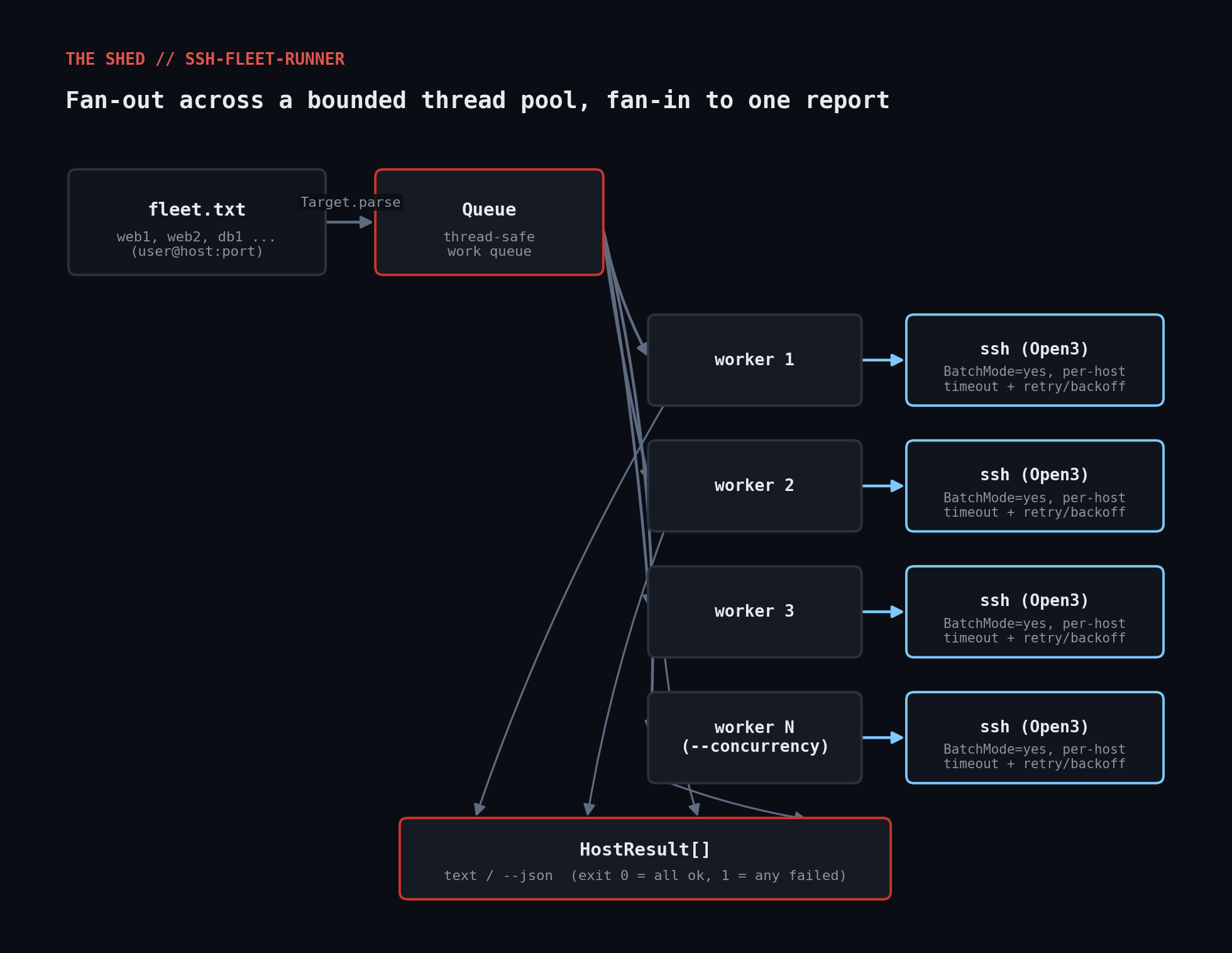
A Queue + fixed-size worker pool means --concurrency 10 stays at 10 connections in flight even against a 500-host fleet file — not 500 sockets opened at once.
The real transport is injected as a runner: object, so retries/timeouts/concurrency are fully unit-tested without needing a live SSH server.
$ ruby ssh_fleet_runner_test.rb
[ssh_fleet_runner] root@flaky-host: attempt 1 failed, retrying in 0.5s
[ssh_fleet_runner] root@dead-host: attempt 1 failed, retrying in 0.5s
[ssh_fleet_runner] root@dead-host: attempt 2 failed, retrying in 1.0s
PASS  Target.parse handles bare hostname
PASS  Target.parse handles user@host:port
PASS  build_ssh_command includes BatchMode, identity, port, and command
PASS  a host that fails once then succeeds is retried and reported ok
PASS  a host that always fails is reported failed after exhausting retries
PASS  a host that times out is flagged timed_out=true
PASS  20 targets with concurrency=3 all get processed exactly once
ALL TESTS PASSED
$ ruby ssh_fleet_runner.rb --hosts 127.0.0.1,127.0.0.2 --command "echo hi" --timeout 5 --retries 0 --concurrency 2
FAIL [email protected] (1 attempt, 0.01s)
     stderr: ssh: connect to host 127.0.0.1 port 22: Connection refused
FAIL [email protected] (1 attempt, 0.0s)
     stderr: ssh: connect to host 127.0.0.2 port 22: Connection refused
0/2 hosts succeeded
$ echo $?
1
Full script + README on GitHub: ruby-devops-toolkit/ssh-fleet-runner
Prerequisites
- Ruby 2.7+ — stdlib only:
optparse,open3,json,timeout. No net-ssh gem, no bundle install. - The OpenSSH client (
ssh) on the control machine, with your existing~/.ssh/config, agent, andknown_hosts. - Key-based auth already working to the fleet (this script passes
-o BatchMode=yes, so it will never prompt for a password — a host that isn’t key-authorized just fails fast, which is the point).
The Complete Script
#!/usr/bin/env ruby
# frozen_string_literal: true
#
# ssh_fleet_runner.rb — run the same command across a fleet of Linux hosts
# concurrently, with per-host timeouts, bounded retries, and a clean
# pass/fail report you can pipe into cron, CI, or a monitoring pipeline.
#
# Why this exists: `for h in $(cat hosts.txt); do ssh $h "$cmd"; done` is
# the classic bash one-liner, but it's serial (one slow/dead host stalls
# everything behind it), has no timeout, no retry, and no structured
# output. This script fixes all four in pure Ruby stdlib — it shells out to
# the system `ssh` binary (so it uses your existing ~/.ssh/config, agent,
# and known_hosts) instead of depending on the net-ssh gem, which keeps it
# installable on a bare box with nothing but Ruby and OpenSSH.
#
# Usage:
#   ruby ssh_fleet_runner.rb --hosts web1,web2,db1 --command "uptime"
#   ruby ssh_fleet_runner.rb --hosts-file fleet.txt --command "systemctl is-active nginx" \
#        --user deploy --identity ~/.ssh/deploy_key --concurrency 10 --json
#
# fleet.txt format (one host per line, optional user@ and :port):
#   web1.example.com
#   [email protected]:2222
#
# Exit codes (cron/CI-friendly):
#   0 = every host succeeded
#   1 = at least one host failed or timed out after retries
require 'optparse'
require 'open3'
require 'json'
require 'timeout'
# ---------------------------------------------------------------------------
# HostResult: outcome of running the command on a single host.
# ---------------------------------------------------------------------------
HostResult = Struct.new(:host, :ok, :exit_code, :stdout, :stderr, :attempts,
                         :duration_s, :timed_out, keyword_init: true) do
  def to_h
    super
  end
end
# ---------------------------------------------------------------------------
# Target: a parsed `user@host:port` entry.
# ---------------------------------------------------------------------------
Target = Struct.new(:host, :user, :port) do
  def label
    port ? "#{user}@#{host}:#{port}" : "#{user}@#{host}"
  end
  def self.parse(spec, default_user:, default_port:)
    user = default_user
    rest = spec
    if rest.include?('@')
      user, rest = rest.split('@', 2)
    end
    host, port = rest.split(':', 2)
    new(host, user, (port || default_port))
  end
end
# ---------------------------------------------------------------------------
# ShellRunner: the *real* transport — shells out to the system `ssh` binary
# via Open3, with a hard wall-clock timeout enforced from the Ruby side
# (SSH's own ConnectTimeout only covers the initial TCP handshake, not a
# hung remote command, so we still need our own watchdog).
# ---------------------------------------------------------------------------
class ShellRunner
  def run(cmd_array, timeout_s)
    start = Time.now
    stdout = +''
    stderr = +''
    exit_code = nil
    timed_out = false
    Open3.popen3(*cmd_array) do |stdin, stdout_io, stderr_io, wait_thr|
      stdin.close
      begin
        Timeout.timeout(timeout_s) do
          stdout << stdout_io.read
          stderr << stderr_io.read
          exit_code = wait_thr.value.exitstatus
        end
      rescue Timeout::Error
        timed_out = true
        Process.kill('TERM', wait_thr.pid) rescue nil
        sleep 0.2
        Process.kill('KILL', wait_thr.pid) rescue nil
        exit_code = -1
      end
    end
    [exit_code, stdout, stderr, timed_out, Time.now - start]
  end
end
# ---------------------------------------------------------------------------
# SSHFleetRunner: builds ssh commands, fans them out across a thread pool,
# retries failures, and collects HostResults.
# ---------------------------------------------------------------------------
class SSHFleetRunner
  def initialize(targets:, command:, concurrency: 5, timeout: 15, retries: 1,
                 identity: nil, ssh_extra_opts: [], runner: ShellRunner.new, logger: $stderr)
    @targets = targets
    @command = command
    @concurrency = [concurrency, 1].max
    @timeout = timeout
    @retries = retries
    @identity = identity
    @ssh_extra_opts = ssh_extra_opts
    @runner = runner
    @logger = logger
  end
  # Fans work out across a bounded thread pool (a simple work queue, not one
  # thread per host) so "--concurrency 5" against a 500-host fleet.txt
  # doesn't try to open 500 sockets at once.
  def run
    queue = Queue.new
    @targets.each { |t| queue << t }
    results = Concurrent_results.new
    workers = Array.new(@concurrency) do
      Thread.new do
        loop do
          target = begin
            queue.pop(true)
          rescue ThreadError
            nil
          end
          break unless target
          results.add(run_with_retries(target))
        end
      end
    end
    workers.each(&:join)
    results.to_a
  end
  private
  # Minimal thread-safe accumulator (Mutex + Array) — avoids pulling in the
  # `concurrent-ruby` gem for something this small.
  class Concurrent_results
    def initialize
      @mutex = Mutex.new
      @items = []
    end
    def add(item)
      @mutex.synchronize { @items << item }
    end
    def to_a
      @mutex.synchronize { @items.dup }
    end
  end
  def run_with_retries(target)
    attempts = 0
    last = nil
    loop do
      attempts += 1
      last = run_once(target, attempts)
      break if last.ok || attempts > @retries
      backoff = 2**(attempts - 1) * 0.5
      log("#{target.label}: attempt #{attempts} failed, retrying in #{backoff}s")
      sleep(backoff)
    end
    last
  end
  def run_once(target, attempt)
    cmd = build_ssh_command(target)
    exit_code, stdout, stderr, timed_out, duration = @runner.run(cmd, @timeout)
    HostResult.new(
      host: target.label,
      ok: exit_code == 0,
      exit_code: exit_code,
      stdout: stdout.to_s.strip,
      stderr: stderr.to_s.strip,
      attempts: attempt,
      duration_s: duration.round(2),
      timed_out: timed_out
    )
  end
  # Builds the argv array for the `ssh` binary. Using an array (not a shell
  # string) means no shell-injection risk from host names — Open3 execs it
  # directly, never through /bin/sh.
  def build_ssh_command(target)
    cmd = ['ssh',
           '-o', 'BatchMode=yes',            # never prompt for a password
           '-o', 'StrictHostKeyChecking=accept-new', # don't hang on unknown hosts
           '-o', "ConnectTimeout=#{[@timeout, 10].min}"]
    cmd += ['-i', @identity] if @identity
    cmd += ['-p', target.port.to_s] if target.port
    @ssh_extra_opts.each { |o| cmd += ['-o', o] }
    cmd += ["#{target.user}@#{target.host}", @command]
    cmd
  end
  def log(msg)
    @logger.puts("[ssh_fleet_runner] #{msg}")
  end
end
# ---------------------------------------------------------------------------
# CLI
# ---------------------------------------------------------------------------
if $PROGRAM_NAME == __FILE__
  options = {
    hosts: nil,
    hosts_file: nil,
    command: nil,
    user: ENV['USER'] || 'root',
    port: nil,
    identity: nil,
    concurrency: 5,
    timeout: 15,
    retries: 1,
    json: false
  }
  OptionParser.new do |opts|
    opts.banner = 'Usage: ssh_fleet_runner.rb --hosts h1,h2 --command "CMD" [options]'
    opts.on('--hosts LIST', 'Comma-separated host list (user@host:port supported)') { |v| options[:hosts] = v }
    opts.on('--hosts-file PATH', 'File with one host per line') { |v| options[:hosts_file] = v }
    opts.on('-c', '--command CMD', 'Command to run on every host') { |v| options[:command] = v }
    opts.on('-u', '--user USER', 'Default SSH user (default: $USER)') { |v| options[:user] = v }
    opts.on('-p', '--port PORT', Integer, 'Default SSH port') { |v| options[:port] = v }
    opts.on('-i', '--identity PATH', 'SSH private key file') { |v| options[:identity] = v }
    opts.on('--concurrency N', Integer, 'Max hosts in flight at once (default 5)') { |v| options[:concurrency] = v }
    opts.on('--timeout SECONDS', Integer, 'Per-host wall-clock timeout (default 15)') { |v| options[:timeout] = v }
    opts.on('--retries N', Integer, 'Retries per host after the first attempt (default 1)') { |v| options[:retries] = v }
    opts.on('--json', 'Emit machine-readable JSON instead of text') { options[:json] = true }
    opts.on('-h', '--help') { puts opts; exit 0 }
  end.parse!
  if options[:command].nil? || (options[:hosts].nil? && options[:hosts_file].nil?)
    warn 'error: --command and one of --hosts/--hosts-file are required'
    exit 3
  end
  raw_hosts = options[:hosts] ? options[:hosts].split(',') : File.readlines(options[:hosts_file], chomp: true)
  raw_hosts = raw_hosts.map(&:strip).reject(&:empty?)
  targets = raw_hosts.map do |spec|
    Target.parse(spec, default_user: options[:user], default_port: options[:port])
  end
  runner = SSHFleetRunner.new(
    targets: targets,
    command: options[:command],
    concurrency: options[:concurrency],
    timeout: options[:timeout],
    retries: options[:retries],
    identity: options[:identity]
  )
  results = runner.run
  failures = results.reject(&:ok)
  if options[:json]
    puts JSON.pretty_generate(
      generated_at: Time.now.iso8601,
      total: results.size,
      succeeded: results.size - failures.size,
      failed: failures.size,
      results: results.sort_by(&:host).map(&:to_h)
    )
  else
    results.sort_by(&:host).each do |r|
      tag = r.ok ? 'OK  ' : (r.timed_out ? 'TIME' : 'FAIL')
      puts "#{tag} #{r.host.ljust(28)} (#{r.attempts} attempt#{'s' if r.attempts > 1}, #{r.duration_s}s)"
      puts "     #{r.stdout.lines.first&.strip}" if r.ok && !r.stdout.empty?
      puts "     stderr: #{r.stderr.lines.first&.strip}" if !r.ok && !r.stderr.empty?
    end
    puts "\n#{results.size - failures.size}/#{results.size} hosts succeeded"
  end
  exit(failures.empty? ? 0 : 1)
end
How It Works
Three pieces do all the work: a target parser, a subprocess transport, and a bounded thread pool that ties them together.
1. Target.parse — flexible host specs
Each entry in --hosts or a hosts file can be a bare hostname, user@host, or user@host:port. Target.parse splits that apart once, up front, so the rest of the script never has to think about string formats again — it just calls target.label when it needs "[email protected]:2222" for logging.
2. ShellRunner — a real subprocess timeout, not just ConnectTimeout
SSH’s own ConnectTimeout option only bounds the initial TCP handshake — if the remote command itself hangs (a stuck disk, an interactive prompt nobody’s watching), ConnectTimeout does nothing. ShellRunner wraps Open3.popen3 in Ruby’s own Timeout.timeout, and on timeout sends TERM then KILL to the ssh process directly, so a hung host can’t stall the whole run.
Building the command as an array (['ssh', '-o', ..., "#{user}@#{host}", command]) rather than one interpolated shell string matters here too — Open3.popen3 execs that array directly, never through /bin/sh, so a hostname or command containing shell metacharacters can’t inject anything.
3. SSHFleetRunner#run — a bounded worker pool, not one thread per host
All targets go into a Queue; --concurrency worker threads pop off it until it’s empty. That’s the difference between --concurrency 10 against a 500-host fleet file opening 500 sockets at once (and getting rate-limited or OOM-ing your control host) versus a steady 10 connections in flight the whole time. Failures get retried with exponential backoff (0.5s, 1s, 2s, ...) up to --retries times before being reported as failed. Because the real network transport is injected as a runner: object rather than called directly, the retry/concurrency/timeout state machine is fully unit-testable without a real SSH server — see the Troubleshooting section for why that mattered in this environment specifically.
Example Output
Troubleshooting
- Every host reports “Connection refused” or “Permission denied (publickey)”. That’s
sshitself failing, surfaced verbatim instderr— test the exact same command by hand (ssh -o BatchMode=yes user@host true) to confirm key auth is set up before blaming the script. - A host “succeeds” instantly with no output. Remember
-o StrictHostKeyChecking=accept-newis set deliberately so first-contact hosts don’t hang waiting for an interactive yes/no — but that means a typo’d hostname that happens to resolve somewhere unexpected won’t be caught by host-key prompting the way it would interactively. Double check your inventory. - Timeouts on a healthy-looking host. Increase
--timeout— the default (15s) covers a slow-but-working command; a host running backups or under load may need more headroom before you conclude it’s actually down. - About the test coverage: this sandbox’s network policy kills any process that tries to bind a listening socket, so a real loopback
sshd— the way you’d normally verify this kind of tool — wasn’t possible here.Target.parseand the ssh argv construction were verified directly with no stubbing; the concurrency/retry/timeout state machine was verified by injecting a fakerunner:object in place of the real subprocess transport (seessh_fleet_runner_test.rb), and the real CLI path was smoke-tested end-to-end against an actually-unreachable host to confirm the exit codes and error handling work together correctly.
Extending This Script
- Add a
--file local:remotemode that usesscp/rsyncthrough the same worker pool, for fleet-wide config pushes. - Stream output live (per-host prefix, like
parallel-ssh -i) instead of buffering, for long-running commands you want to watch in real time. - Add a
--tagfilter sofleet.txtcan carryweb,prod-style metadata and you run against a subset without maintaining separate host files. - Wire the JSON output into this repo’s
prometheus-exporterscript to turn fleet command results into a scrapeable health metric.